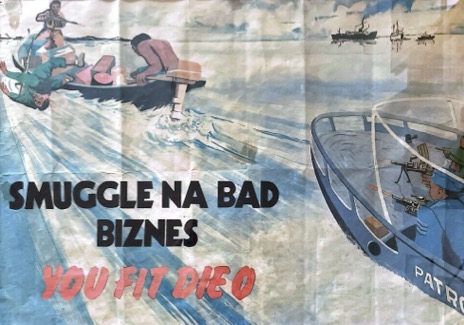
Smuggle Na Bad Biznes
Making Amends in 1981
by
Simon Lawson
“Oh Lord, won’t you buy me a Mercedes Benz?
My friends all drive Porsches, I must make amends
Worked hard all my lifetime, no help from my friends
So, oh, Lord, won’t you buy me a Mercedes Benz?”
Janis Joplin – Mercedes Benz – 1971
“Dope will get you through times of no money better than money will get you through times of no dope.” – Freewheelin’ Franklin in The Fabulous Furry Freak Brothers Cartoon “The Freaks Pull a Heist!”
Gilbert Shelton – 1971
___________
In loving memory of:
“Gray” – Graham Scott Livesey,
“Lil” – Ian Miller
“Benj” – David Benjamin Hewitt
My fellow nomads, desert travellers, masters of the art of “welkdom”, moody operators, companions on the long road where no condition is permanent. Our journeys continue, on different roads. And not forgetting “Saidu Bamenda” and other friends who have gone on ahead of me over the rainbow.
———————————————————–
One
Rita finally relents, unlocks the door and lets us out of her room. She’s standing, hands on hips, facing Lil. “Kawo kudi! Bring money!” as Lil hands her a 100 Guilder note. “Yes, Mr Lil – dis last night wi don enjoy o! Bot dis na Nigeria, we no dey sex for love, we dey sex for money! – Kawo kudi!”, laughing as she grabs Lil and sways her hips against him – just as they’d been dancing, a few hours earlier.
We stagger out of the compound, onto the road, rubbing our eyes, blinking against the sudden glare, and wondering which way it is back to Kaduna? Turning to wave at the girls, we spot a large painted sign that announces, in bold lettering, over a giant cutout chilled Star Beer bottle – Welcome to Merry Makers Relaxation Centre.
_____________________________________________________________
A few weeks earlier:
Sitting at my kitchen table studying, one evening in April 1981, the phone rings. “Hello Quinton.” says a familiar voice, “Hello Quantity.” say I. “How do you fancy a couple of weeks in Af.?” “Well that depends…” I reply rather unconvincingly, “..on what exactly you’ve got in mind?” “I want you to drive a Merc with me and Lil to Nigeria. There’s some money in it.” “I’ll think about it, Graham…” I say, but I’ve already half made up my mind, “..are you coming to little Rachel’s party on Saturday?” “Yeah, I’ll be back from Maastricht on Friday, at me mum’s. I’ll come up to you Saturday afternoon with Benj.” “Ok, great, see you at the weekend then, bye Gray.” and that’s that.
I’m already hooked of course, but try to tell myself that I can’t go. Things are already looking pretty grim regarding my future at the University. The idea of blasting across the Sahara with Graham, in a Mercedes Benz, is tempting to say the least, but I’m in the third year of a PhD in bio-systems, and way behind on my thesis. If I didn’t get it finished I’d soon run out of grant, so the thought of telling my mentors that I’m swanning off to West Africa, for a fortnight or so, seems to spell academic doom. I try to put it out of my mind. But, when Gray turns up a few days later, with a gleaming Must Make Amends – a sweet, metallic brown, petrol, auto 280SE 123 model that he wants me to drive to Nigeria – I finally decide to go, the University be damned. It would only be for a couple of weeks anyway.
“What do you think then Simon? I’ve got three Mercs, there’s me and Lil already, and there’s a thousand Gliders in it for you as well.” I look him in the eye, and say seriously – “I don’t know Gray, I’ll have to think about it… for a few seconds! Of course I will, are you having a laugh?” He grins and we hug each other. “That’s great boy.” he says opening the boot, and pulling out a crate of Grolsch in flip-top bottles, for the party tonight. We go inside to freshen up, with a coffee and a spliff.
“Where’s Benj?” I ask. “He should be here soon, he’s in his own motor.” We talk about the trip. Gray is going to leave the 280 at his mum’s, and take another motor back to Maastricht, where he’s based when not on the road. He was introduced there by his girlfriend Inez, who he’d met in Agadez, Niger, on a previous trip. He’d found that Limburg was a great location to buy good quality used Merc trucks, from across the border in Germany, which he drives to Nigeria and Cameroon, where they are in great demand. I’d met Graham, eight years earlier, camping in City Park, Nairobi. He’d driven there in an old Bedford Army lorry with nine other lads from Essex – known collectively as the Harold Hill Mob. We’d had several adventures together in Kenya, and become great friends. Since then, after a short sojourn in Delhi at the Indian Government’s pleasure, he had clocked up several trips to West Africa. The plan was that I’d pick up the motor from his mum’s in Harold Hill, and drive it to Maastricht the following weekend, meet up with him and Lil, and the three of us would take off for Nigeria. On his most recent journey with trucks, he’d heard that Mercedes cars were making top money there; he even had some clients lined up – like Janis Joplin, apparently many Nigerians wanted to make amends. He thought a two week blast across the desert would be a good way to test the market.
It’s getting late, there’s a party to go to and still no Benj. “He should have been here by now.” We have a beer and roll a joint, and then there’s a knock on the door – and there’s Benj, on foot. “Where’ve you been then Benj?” says Gray. “Oh, well me motor packed up near Bedford didn’t it. F’ing thing just stopped, I’ve no tools or nothing, so I left it, and started to hitch. But no sod would stop.” “How did you get here then?” I ask. “Well I nicked a Cortina, didn’t I – piece of piss.” he says, brandishing a well worn Ford key that would open almost anything.” “You what? Where is it? You haven’t parked it in this street, have you?” I say nervously, fearing an unscheduled appearance of the fuzz at the party. “Nah Simon, I left it round the corner, two streets away, don’t worry mate.”
Benj, was another of the Harold Hill Mob, and Gray’s best mate, who I’d also first connected with in Nairobi – when eight of us hired a Landrover from Seychelles Joe – and drove it up to Lake Turkana for the total eclipse in 1973.
Like Graham, Benj earns his crust buying and selling motors, and now is also into the trans Sahara truck trade.
I’ve cooked keema sag and pillau rice, one of Gray’s favourites, so we munge, while catching up, chatting about recent trips – the state of the roads and the borders, the places and people en route – tales full of incidents, near misses and fun. We’d take the ferry from Marseilles to Algiers, then drive straight south through Algeria, across the desert into Niger, and then to Nigeria and maybe Cameroon, if things got iffy in Naija. My appetite for the journey is growing. My mouth watering in anticipation of my second trans Sahara trip – I’d travelled home in a Land Rover from Ghana in ‘74, and couldn’t wait to get back on the road. Then, suitably stimulated, we set off down the road to Little Rachel’s, for a fun night of sweet soul music, lovers’ rock and randy reggae dancing.
——
By Easter Monday everything is fixed. I’m to pick up the car from Gray’s Ma on Thursday, and meet him in Maastricht, where we would stay for Nell’s party on the Friday night, before setting off the next day. Wednesday night, I’ve been out for a few drinks with some colleagues at the Old Swan at Woughton on the Green – a former haunt of highwayman Dick Turpin. We decide that the best thing for me to do is simply leave a note on my supervisor’s desk and go! I get in late, a bit merry and excited, and decide to call Mo, an old school mate of mine in London. “Hey Mo, fancy coming over to Holland with me tomorrow evening for a party? You’ll have to make your own way back, but if you fancy the trip I’ll take you.” “Sounds fine Simon, fabuloso.”
We agree to meet at Liverpool Street the next evening. Early morning, I go into the department and leave a note on Dr Dick Morris’s desk. He’s a lovely man, and one of the few academics who actually encourages my somewhat eclectic approach to research. I hope he’ll understand. “Dear Dick, a great opportunity has come up out of the blue, and I’m off to Nigeria for a couple of weeks. Sorry for the short notice – hope that’s alright. Best wishes, Simon.” Then home to pack, check my passport and vaccination certificates, and off to London to meet Mo at Liverpool street. We jump on a train to Harold Wood and into a cab to Gray’s mum’s, in Harold Hill. After a cup of tea and a slice of cake, Ma Jean gives me the car keys, papers – a ferry ticket past its return date – “Graham said you’ll have moody that, Simon!” and with a chocolate chip cake for Graham, we set off.
We cruise South, the motor purring through the rolling Essex countryside, the Thames Marshes, Dartford Tunnel and into Kent. It’s a marvellous spring evening, the sky tinged pink as we make our way through the Garden of England, Canterbury, and down the steep hill to the terminal in Dover. With an hour or so to spare, we go for a couple of pints before the ferry. Just as we’re going into the pub we run into some of Mo’s friends, who are just leaving, and speak highly of the Wadsworth’s. They are right as it happens.
We sail through customs, and ticket check, on the moody ticket – the date and number of passengers changed with a blue biro and smudged a bit – and save Mo seven quid into the bargain. Onto the ferry, and straight out on deck, to watch the white cliffs of Blighty slipping away into the dusk. It’s pretty bloody imminent outside though, so we go back in to see if the bar has opened. Hungry, we opt for the three course meal in Club Class, which Mo insists we wash it down with a bottle of Moët. By the time we finish dinner, we’re approaching Oostende, and in need of a livener before hitting the road. We go into the Gents together, into a cubicle, where Mo crushes up a couple of Black-Bombers, which we snort with a £1 note. He has an accommodating Harley Street quack, who readily prescribes him the amphetamine “Durophet”, for a suitable fee.
We make good time through Belgium, the roads being pretty deserted in the early hours of the morning, rocking up at Nell’s gaff on the Rechtstraat just as Gray and Lil are getting up and at it for the day, Nell having already left for work. After greetings, and our effusive speed fuelled account of our night on the ferry, – Gray taking one look at the wide eyed state of us says to me pointedly: “Champagne eh, very nice! And there’s you driving my motor an’ all.” We have coffee, and get our heads down, while Gray and Lil go off to fetch one of the Mercs from Aachen and buy some spares.
Early afternoon, we check out Mo’s return journey at the railway station, where, after a phone call home, he decides that the chance of a weekend in Amsterdam, with all its business possibilities, would be too good to miss, so he’ll leave me with my friends and the journey ahead. But first we stroll along the old cobbled streets of Maastricht to the Vrijthof and the In den Ouden Vogelstruys (In the Old Bird’s Story) café, to take a look at the dozens of pencil portraits of its regulars – drawn over half a century – which line the walls of the bar. Then after a swift glass of Brand Bier we walk back to the Rechtstraat where Mo makes his excuses – to a few jeers from Graham and Lil… “Oh yeah – You got pressing bizness up there in the D’am. Ha ha, yeah, we understand don’t we? We’d come with you but we’ve got our own bizness to attend to in Nigeria. Have fun.” And with that Mo is off back to the station.
Nell returns with daughter Inge in tow. She’s close to Inez, and that’s how Gray ends up kipping on her living room floor, whenever he is in Maastricht. We hug warmly – we’ve been friends and occasional lovers over the last couple of years and it’s fab to see her. Then it’s off to the chip shop at the end of the street for a mountain of frites met mayo, frinkandelspecials, and loempias, which we all munge while helping Nell sort out the flat for her party. Gradually friends from the Maastricht scene arrive, Bart, Birget, Ger and others, most of whom I know, having spent Carnival with them a couple of years earlier, and visited Nell a few times since. It’s a fun evening, but one on which mindful of le départ scheduled for the following day I try not to get too wasted.
Two
Late next morning, it’s wake up coffees and down to business. We roll up our sleeping bags, kiss and hug Nell goodbye, and it’s tot ziens and bon voyage. Down at the station carpark, all three Mercs are now lined up side by side. Next to my 280SE there’s a green metallic 450 SEL – driver leader Graham’s of course – and by that a sleek brown metallic 280S coupé, which is Lil’s ride, all gleaming and glinting in the spring sunlight. We throw our bags into the cars, cross the road to a café, and sit at a table opposite the motors, ordering coffees and uitsmijters – literally translated as bouncers – open sandwiches with fried eggs on top of slices of ham, cheese and bread – which we smear with hot sambal and devour ravenously.
“Ok” says Gray as he reaches into the pocket of his signature horse-hide jacket, and pulls out a wodge of 100 Guilder notes. He counts off ten for me, another ten for Lil – about 200 quid each – and says “there’s your wages, welcome to the firm.” The waiter comes with the bill and I start to put down a note, but Gray stops me. “That’s your dosh boy, I’ve got it.” and Lil chips in with “Yeah Simon – you’re on the firm now – with GSL Overland – all expenses paid.” grinning through his curly mane and squinting through his Lennon glasses.
GSL Overland, as in Graham Scott Livesey Overland is the moody company name Gray has ‘traded’ under since his first journey to Nigeria with paying passengers, a couple of years earlier. He’d advertised a cheap Overland to Africa trip, in the personal ads paper Exchange and Mart. He’d loaded eight punters into the back of a Chelmsford Borough Council dustbin lorry, which he’d bought at auction. Legend has it that it wasn’t even washed out, and you could still see the fried egg stuck to the sides. Nevertheless, they made it to Nigeria and sold the lorry to Lagos City Council – where it’s probably still doing the rounds – and that was the start of his trans-sahara truck sales business of which our coming journey was the latest iteration.
“Ok then, time to frappé la route. We’ll stop at the Belgian border to tank up – OK? Si you follow me and Lil you take up the rear. And, Si keep Lil in your mirror, and if you lose him stop and I’ll come back for you.” And we’re off.
We head out of town towards Liege, purring along in convoy. Pulling into the services 20 minutes later at Visé, just before the frontier, to check the tyres, oil and faire le plein. As we are doing this Gray pops off the Mercedes wheel cap from the centre of one of his alloys and hides our hash stash – though we each have a small lump hidden in packets of Sampson tobacco for the road. And then we’re off through the border, and south into the rolling wooded hills of Ardennes towards Luxembourg. Smooth cruising at 140 Ks, motors swooping along eating up the road. A stop at a view point to survey the scenery, where I narrowly miss a rock and get jeered by Graham who threatens to sack me.
Onto Luxembourg, where the pizzas are top but the hotels are way trop chère – so it’s onto France. At the border, the customs officer cannot believe our African deal. He goes over the cars checking all the window winders, seemingly more concerned with checking the upholstery, mileage and the condition of the cars, than searching for any contraband, saying to Gray: “C’est intéressante cette bagnole, vous voulez combien?” After about a year, the computer check seems to satisfy them, and we are on our way.
It’s getting late when we get to Thionville, and find a hotel, which is somewhat moins chers than those in the Grand Duchy. We settle into our room for a few beers and a late night spliff. Lil has taken the Blaupunkt cassette player out of his car because it’s giving him jeopardy. It’s chewed a tape and stopped working. While we smoke some ting, he gets to fixing the problem with the broken drive band on the cassette, and I salvage the mangled tape – rolling it back into the cassette over a pencil. “Yes” says Gray “We have all the tools of the trade for this very delicate job, brute force and another welkdom, and we are halfway there.” So we drink another beer, and Lil’s down to his last rubber band. “World rubber resources are running out over there, no problem di ting resources are not running out.” Five knots later, Lil’s “Done it! Yes fixed it!” “Is it all spinning? Yeah great, it’s welkdom if you done that.” “Yeah that should work alright, be great if it works – going to roll another joint and go to bed maybe it’s going to work, I need tools…”
There’s a banging at the door to shouts of “La Police – monsieur!” Paranoia! – Lil and I rudely awakened, jump out of bed, hide our stash under the blankets, and open the door. It’s just the patron, telling us that the police are clearing the square for le marché, and we have to move our cars. We rouse Gray who’s still dozing. It’s already 10.30, although it feels more like half past five so we move the cars, and after cafés and croissants, it’s on y vas sur la route.
Langres, a stop at a café for sandwiches and a beer, and get chatting to some local youth who are playing table football in the bar, at which Lil is a bit of a dab hand. I invite Nicole – pretty, petite and hippyish – to come with us, for a moment it looks like she’s up for it “Oui, je veux, mais demain c’est l’école.” So we exchange addresses and it’s back on the road.
A couple of hours later and no Lil.” I wait. “He’s a blind git” says Graham “better go and look for him.” Up the road a mile back we find him stopped – he’d turned back to look for us! We sweep on down through Dijon, Chalons, and Macon making good progress as being Sunday the roads are free of trucks. Stop for fuel and munchies, and Lil has a spot of bother with a hitchhiker – who looks like Frankenstein with cold turkey – so we don’t take him. Nice cruising at dusk on the Autoroute du Soleil, welkdom and pretty colours, lilac and springtime in the Ardeche.
We reach Marseilles by 9.30 and head straight for the old port to find a hotel. Like most port cities, the back streets around the docks are pretty seedy, but also full of cheap hotels. After a full day’s driving – around 800Kms we’ve worked up quite a thirst. Stumble into the first bar we come to, play a little pool and table football, before smoking a little number with some Moroccan guy outside. Off to another bar up the hill into the town, where I give some passing fille “Allo, allo!” She sits with us awhile and then invites us to join her friends in yet another bar – a little band of slightly punkish people who seem quite alright, according to Lil. So there we stay until late, drinking and shooting de shit. Gray wants to go home, so does Elodie. Lil and I want to go with her and her friend, but after much asking it’s “La prochaine fois, à demain et bonne nuit.” Us three stagger back to the Hotel Joliette, where we smoke a little welkdom and so to dormi.
Monday morning. Graham is up, off and out down to the port, to buy tickets for the ferry to Algiers. An hour or so later he’s back, telling us the Classe Cabine is really très cher, trop cher même, so he’s only booked one cabin; and that Lil and I are going Classe Economique with the goats! Thanks guv! Then he hustles us to come and drive the cars into the port where we park them up ready for the next day’s ferry. And that’s work finished for the day.
Marseille is the gateway to Africa. It bustles with a rich mix of people, a babble of languages and cultures, from francophone Africa and beyond – Senegalese street traders with their colourful wares spread out on the pavement, and Moroccan cooks grilling merguez on street corners – wafting spicy aromas into the spring air. Gray loves his food, so we settle on a restaurant and feast on Salade Niçoise, Omelets de fromage, steak haché and frites, washed down with half pints of Kir – relaxing in sun, watching the world go by. After lunch we wander off down to the Quai du Port. It’s a beautiful day, sun-dappled light filtering through freshly leaved plane trees. As we wander the Quai grooving on the yachts, fantasizing about sailing the seas, – Lil telling us about when he’d hitched a ride on a small yacht from Ibiza to the Caribbean and ended up in Brazil – we witness an amusing scene. A Vietnamese looking guy is pursuing a brass along the trottoir, at least he seems to think she’s a brass. But she’s not having any of it. He’s creeping along after her and she’s trying to lose him. Every time she changes direction so does he. She starts to cross the road so does he, eventually they have words and he gives up the chase. We giggle and jeer at that, really très drôle. On another corner there are some hippies doing tricks on the pavement. One guy is laying on the ground with a lot of broken glass on his arm the other’s asking for money. Don’t know if he cut himself or not, we didn’t stay to watch, “France is full of puffy people but Marseille is full of gangsters and stray cats” comments Lil.
Back at the hotel Lil gets to fixing his cassette player with the part he’s paid Fr.20 for – a good price for a precision elastic band. “C’est chère mais oui. C’est comme ça” said the electrician in the shop. But now it works, and Lil has his sounds for the desert. Jeopardy! Later after a few beers, we drift out to the bar next to the hotel. But it’s Monday and there’s no sign of our friends from last night. So we drink some beer and loon around the red light district, Graham gets jeered by a mammalian on the corner: “Regarde-toi dans le miroir et fais toi belle.” – “Look in the mirror and tart yourself up!” – she shouts at him. Brasserie! And on to a dark and sleazy bar. Lil refuses to go in at first, then after a few come-ons he’s there. Immediately on entry we almost get seduced by the brasseries, but it’s Fr.15 a beer – so it’s trop chère and au revoir, à la prochaine. A final look for our friends and back to the hotel for, a welkdom of course. We’re all wasted and looking forward to Classe Cabine and Classe Economique.
In the morning waiting to board the ferry, there’s a bit of a panic when Graham thinks he’s lost his passport – much adrenaline. He accuses me of losing it when I pulled my bags out of his motor, but then the quantity finds it in his wallet. As I go to take my sleeping bag out of my car, Gray says “You didn’t really think I’d let you go économique did you?” Not a bad boss as it goes, one has certainly had a lot worse. The boat is très smart and très vite. There’s three bottles of wine on the table – red, white and rosé – when we sit down, and the three course menu is great. So we crash after lunch with a welkdom, and wake about an hour before dinner.
After a coffee to come to, we go to the small duty free shop, where Gray buys a dozen bottles of Johnnie Walker Scotch Whisky – the world’s most popular scotch – to sell and barter en route. Champagne is served as an aperitif followed by a really nice six course dinner. Back in the cabin drinking brandy and smoking welkdom, rapping about various trips we could do, and have done. “..cruising across the desert in a 280 SE not even in your wildest fantasies is it?” “No, now I’m fantasizing about a boat. Too much decadence.” “I could do with a randy dance now…”
Three
The following morning, we wake about half an hour before docking, feeling veritably healthy all things considered. On deck Algiers looms out of the bay, white buildings across the hillside, gleaming bright in the morning sun, between scudding clouds, beckoning our coming journey, three thousand five hundred kilometres south across the Sahara to Kano. It’s squally out though, pretty bloody imminent in fact, so we head inside for warming coffee and croissants before disembarkation.
Customs and immigration, suitably chaotic for a welcome to North Africa, require only a modicum of patience and a bit of queue jumping. We park up two of the cars in the port outside the customs house, figuring they’d be reasonably safe there, and set off for the Nigerian Embassy in Gray’s motor, to get our visas. There, even the Algerian women secretaries are pretty Nigerian and the Nigerian chief is very Nigerian. He looks like he has a raging hangover. He’s thinking with obvious strain as though perplexed, pacing around and stopping, stooping forward and placing his hands on his forehead. We didn’t know then, but a general strike was brewing and he was obviously concerned not to make the wrong decision, because as any Nigerian will tell you: “No condition is permanent.” Eventually he insists that because of the cars he will only issue 10 day transit visas, giving us enough time to drive through Nigeria, but not to stay. So we agree, unaware of portended problems, and say we’re heading for Cameroon. Paperwork and passports submitted and fees paid, we set off into town for lunch, hoping to return on the Saturday morning for our visas.
Algiers then was a vibrant contrast of traditional and modern, Arab, Berber and European. The vast majority of city folk, women included, dressed à la mode, in clothes not out of place in Paris or Marseilles. While visitors from the northern hills and desert towns, are more traditionally attired in hooded dark woolen djellabas, or sporting vast turbans and flowing desert robes of blue and brilliant white cotton. In the upper town, where street vendors grilling merguez, liver and lamb kebabs, and sandwich makers, jostle for pavement space between the chic, french, colonial café terraces. We feast on grilled meats, pizza, egg semolina sandwiches and coffee, sat outside a café watching Algiers go by. Ogling all the pretty girls as three pretty horny boys will do.
Then back to business, down to the port, and off to Zeralda, a little way east out of town, to prep the cars for the desert while waiting for our visas. At the first hotel, we ask for a double room with an extra mattress, but they won’t wear, it so we go to another where we just take a double for the three of us, and we crash out early.
Thursday dawns and we have work to do. Gray knows a friendly garage where they let us use their workshop ramps to service the cars. Oil and filters first, replacing standard multi-grade with SAE 40, a thicker oil suitable for African temperatures. We fit oil soaked rags over the air intakes, an extra precaution against the dust of the desert and dirt roads ahead. Then we bolt on sump plates that Graham has bought from Mercedes in Germany and we’re set.
It seems a bit frosty as we walk into the coffee house. Groups of men stop their conversations, turn to look at us, before turning away as we approach the curved wooden counter to order our coffees in French. But then after we’d been chatting amongst ourselves in English, a middle aged guy standing near me at the bar asks us where we’re from. On hearing that we’re English he and a few of his friends, greet us warmly and ask what we’re up to in Algeria. They make a point of telling us that they’re happy we’re not French. Twenty years on from independence and the scars are still sore. Ahmed, explains that in his early 20’s he had been tortured for over four years during the liberation struggle. We chat generally for awhile, about our journey, and, as it’s wet out, the spring rain, which he says is good for the crops. As we go to leave Ahmed pays for our coffees.
Tomorrow being Friday, it’s the weekend. We smuggle a bottle of wine into the disco, as the whisky is 25 dinar shot! There’s four fresh bottles of Johnnie Walker on the shelf that look suspiciously like those we sold to a waiter in the hotel earlier. Rai music is playing from the various Chebs, the popular dance music of the time, so we bop around for a bit, amongst the predominately male crowd on the dance floor, before staggering outside for a spliff. There we run into Nadia and Zohra who work in our hotel. We smoke and chat with them and their friends, and then they ask us if we could run them home to Algiers, as it’s late and they have no transport. We’re up for it and we all cram into Gray’s motor. Lil, me and the two girls in the back engage in a little naughty, stoned fumbling on the way.
They live in a small rather austere apartment, in a soviet era council block. We dance around the tiny kitchen, chat and flirt into the early hours, until the Pastis, theirs, and the hash, ours, are done. We stagger out into the deserted streets to find our way back to Zeralda. Down a long steep hill and around a sweeping bend we run into a police road block. “Papiers monsieur?” they demand of Graham through the window. Of course, it’s the old story, all our documents are back at the hotel. We’re driving totally wasted with no ID in Algiers at 3 o’clock in the morning – Jeopardy to say the least. Fortunately “les flics” are friendly, and after much rummaging around, apologies and explanations in broken, pissed French, I find an AA membership card in my wallet that seems to satisfy them, and with a grin and a laugh they lift the barrier and bid us good morning. Two road blocks later – which we are waved through, as the first guys had thoughtfully radioed ahead – we make it back to our hotel. Fun night.
Friday afternoon – like Sunday at home – and there’s nothing to do except hang out in the hotel. There’s no hash left, but Lil produces a little lump of O that he has squirrelled away, so we chill and space out playing cards with the boys, and flirt with Nadia and Zohra, while they prepare some delicious pasta.
Saturday morning. At the Nigerian Embassy, a harassed uniformed security officer is barring the entrance, and shouting at a small, agitated, jostling crowd. “Visa collections only, di consular section don klos ontil forda notis. You must disperse!” We wave our visa receipts at the guard who grabs them, disappears inside, and slams the door shut. We are pressed against the entrance by the small throng, who are speculating wildly about the situation in Nigeria, and getting quite heated. Ten rather fretful minutes pass – the door opens a crack and an arm appears holding our three passports which we grab, and force our way out through the crowd. There’s clearly no time to lose so we hit the road for Nigeria.
Heading towards Blida, our little convoy of Mercs – Gray in front, me in the middle and Lil in the rear – climbs out of Algiers on Route 1 across the coastal mountain range. The road is good. It winds smoothly through the green hills and valleys, there’s not much traffic, so we make good time. As we pass through small towns, we slow to a crawl for pedestrians, donkey-carts, busses and long distance Peugeot taxi-brousse overloaded with passengers and baggage. We’re averaging around 100 Ks an hour on the open road, but ever mindful of what could be lurking around the next bend, like a broken down truck, jacked up in the middle of the road, with just a few small rocks laid out before it as a hazard warning. A couple of hours in, the landscape flattens out a bit, and is noticeably more arid. At Djelfa, which begins to feel like a desert town, we lunch on fried egg, aubergine and chip sandwiches, spiced with harissa, washed down with lemon sodas, and strong Arabic coffee.
Now the road is really starting to open out, gradually descending into the Sahara and we’re picking up speed. As we come into Ghardaia, it’s dusk, or eyeball o’clock, as Gray calls it, when the light plays tricks with your eyes. So with a hundred or so Ks still to go, we stop for a coffee, to let it get properly dark. Now we’re headed for Hassi Fehal, an oasis by the road where Gray has some friends. It’s around 8 o’clock when we pull off the road and park up by an adobe compound. A door in the wall opens and a couple of torch beams light us up followed by voices and greetings: “C’est vous Graham? Oh, mon frère. Salem alecum, la besse la besse” as Kader grips Gray’s hand and embraces him warmly. He and his mate Ali then greet Lil, and are introduced to me. “Venez, venez – yallah,” they say practically dragging us inside.
Kader, his brother and a few friends are graduates of the University of Algiers, who have settled this oasis. The government has said, in a bid to stimulate development of the Sahara, that anyone who cultivates desert land can claim it for themselves. And that’s exactly what these former city boys are doing. In just a few years they’ve built a multi-roomed compound, planted vegetable gardens, watered from the oasis, and are raising chickens, sheep and goats, where before were only date palms. The hospitality is traditional, we’re seated on woven floor rugs, in a rectangular mud walled room, lounging on brightly coloured cushions. Tea first, served from a silver metal pot on a silver tray, by Kader. Following ritual he pours tea into a glass from a height, foaming it up then adding sugar before pouring it back into the pot. The process is repeated three time before it’s served to us in three small glasses. Whisky Arabe they call it. Then mixing and pouring again until we’ve drunk three glasses each, the first tea bitter like life, the second sweet as love and the last smooth like death. We chat as we drink. Graham explains that we’re just doing a quick trip with cars, but that he’ll be back later in the year with trucks and the usual bundles of used clothes, second hand fridges and other stuff to trade as previously. “Pas de problem – mon frère, merhaba bien venu, comme toujours.”
A plastic kettle of water and a bowl are passed around for hand washing, then Ali shakes out a table cloth on the carpet in the middle of which a wide round tray piled high with stew and couscous is placed. We gather around the food, and eat together from the tray with our right hands. Our hosts, tearing tasty morsels of goat meat from the bone and placing it in front of us, pressing us to eat. Stuffed we lay back on the cushions, and after a few cigarettes, pull blankets over us and crash for the night.
Four
“Allau akbar, Allau akbar” it’s just before dawn, the call to pray from the makeshift mosque – a low mud wall enclosing a rectangle of stamped earth – rouses us. By the time we make it outside, the guys are rolling up their prayer mats, and preparing coffee on a paraffin stove. We stand around shivering a bit, stamping our feet, pulling our cheche scarves tight around our necks against the morning chill, and fumbling to roll cigarettes with frozen fingers. The sun a giant reddish orange blaze just cresting the horizon to the east. Warmed by the strong sweet coffee we say our good byes, “Ma salaama” – go with peace – “à la prochaine inshallah” – until next time by god’s will – and we’re off.
The road is good, flat, and straight, across the scrubby barren terrain, tapering to a dusty vanishing point on the horizon. My Merc purrs along smooth and comfortable at an easy 120 Ks, And the beat goes on – pumping from the speakers. An hour or so later, the sun is already high. El Goléa shimmers at the end of the road. It’s pretty much a one horse, or rather a one camel town. We pull up outside the two pump petrol station, and ease ourselves out of the cars. A small but stocky man, moustachioed, wearing a keffiyeh on his head and one of those blue canvas jackets – so beloved of French workers – comes out of the glass framed office to greet Graham, who he kisses on both cheeks. “Merhaba Graham, salaam alecum, la besse. Monsieur Lil, merhaba, merhaba.” We shake hands, as I’m introduced to Hamed, who is evidently delighted to see us. We’re led inside his house, behind the workshop, where we sit cross legged on carpets, while his wife and two daughters serve us mint tea, and then disappear.
Gray and Hamed talk business, they are old friends now, Graham having traded old fridges and other gear – salvaged from the streets of Limburg on bin days – for diesel on previous journeys with trucks. Once the tea is drunk, the women return, and without a word, place a massive tray of couscous in front of us. Hamed asks Gray if he can bring a display fridge with him next time, as he’s doing quite well selling ices from the garage now, in the meantime he’s quite happy to faire le pleine – fill the cars and our 12 x 25 litre plastic bidons – 4 in the boot of each motor – with petrol – about 500 litres – in exchange for 6 bottles of Johnnie Walker.
The cars tanked up, we go for a stroll through the town, to walk off our lunch, and buy some basics for the road ahead – tins of sardines, boxes of La Vache qui Rit cheese and a few bottles of mineral water – to keep hydrated. The grocer greets us with the same enthusiasm as Hamed, and we’re invited into the back of his shop for tea. As before tea is followed by couscous without a word! We struggle our way through, as we’re already stuffed, but you simply cannot refuse hospitality in Algeria. Finally, our host seems satisfied that he’s fed us adequately, and we start to stroll back to the garage. Before we’ve gone more than a few yards, another chap grabs Gray by the arm, and the whole scene is repeated. By now we are so bloated, that it’s painful to do justice to the food – delicious as it is. At last honour is satisfied. We literally stagger out onto the road, our bellies tight as drums, after our third couscous in as many hours. Back to the cars, and with a final ma salaama and a wave to Hamed, and his family, we’re off to In Salah.
Overhead the sun is white-hot – a ball of fire, broiling the blacktop as we drive south into a shimmering liquid mirage. It’s a toss up whether it’s cooler to drive with the windows open, or with them closed and the ventilator on full. Either way it’s like sitting in a blast furnace. To either side, there are rocky grey outcrops, their contours traced by parched wadis across the bright, biscuit desert floor. I give thanks for my RayBan Wayfarers. After a couple of hours of gentle descent, the landscape smoothes to a bleached terracotta. We speed on. The sun is low, brushing the horizon, when we roll into In Salah, and pull up, in a line, in front of Hadji’s Hotel.
Hadji himself, seated on a low bench by the door, stands to check out the new arrivals. He’s a tall Tuareg. A striking man. Flowing blue robes, billowing in the evening breeze. Eyes sparkling from a jet black face, framed in brilliant white by a turban that’s wrapped multiple times around his head, with under chin turns set to pull across his face against wind driven sand. His neck festooned with square, leather-bound gris-gris charms, and the copious finely worked wallet of a successful man.
“Graham – c’est vous? Alhamdulillah – praise god – salaam alecum, la besse la besse.” as he shakes Gray’s hand vigorously with both hands. “Monsieur Lil aussi! Salam alecum.” He meets my eyes with an intense gaze, welcoming smile and firm handshake as I’m introduced, and greetings exchanged we’re invited inside. The mud walled room is cool and dark, covered with brightly coloured rugs, cushions, benches built into the walls and low, round, dark wood inlaid tables. After tea, and the inevitable fourth meal of the day, as night falls, we take our leave for the hammam to bathe.
From the outside, the bath house is a nondescript red adobe building. We pay the attendant a few dinar, at a table by the door, are handed towels to wrap around us, for modesty, and ushered into an ante-room, where we remove our shoes, placing them neatly, with others, in a row against the wall. We undress, hang our clothes on pegs, and, towels around our waists, enter the hammam, through a beaded curtain, into a windowless, steam filled room, walled with glazed blue and white patterned tiles. There are taps set into the wall on one side, a metre or so apart, at which a few other men sit or squat, washing from plastic buckets. We do likewise, before relaxing, seated on the heated central island bench, formed out of the same polished cement as the floor. It’s a relief to wash away the desert dust, from body, face and hair, and sweat away the tension from the day’s drive. Clean and relaxed, we head out to spend the night in the dunes, on the edge of town.
Comme d’habitude, the dawn call to prayer rouses us from a deep sleep nestled comfortably in our bags in the soft sand. Lil, who’s quite paranoid about creepy crawlies, reminds us to shake our clothes and check our shoes for scorpions that might have taken up residence overnight. Then it’s back to Hadji’s for a wake up coffee, and to bid him “Ma salaama, à la prochaine, in shallah” and frappé la route for Tamanrasset, wondering what shape the road is in. So far so good. We enter the top of the Arak Gorge around two hours later and stop for breakfast – fried eggs again! The road through the gorge has been recently resurfaced, so we make good speed, swooping along, winding through the stunning towering rock formations, rising to 500 metres, on either side. It’s like driving through a giant Henry Moore exhibition.
The road flattens, straightens out and is generally worse for wear. At times we slow to a crawl, dodging the enormous pot holes. Graham calls a halt and jeers me for driving too fast: “Stop driving up my arse Simon, fucking slow down boy. Who d’you think you are – Roy Rogers? Follow my lead!” In some sections, the surface is so bad we’re forced to leave it, to duck and dive, on and off the sandy piste of vehicle wheel tracks, to one side or the other of the shattered tarmac. Mostly this is smoother going. But, in places, it’s so corrugated that we’re forced to slow our pace again to avoid shaking the cars to bits, even Mercs can only take so much! Either that or drive so fast that we sail over the top of the corries, like in the film Wages of Fear as I suggest to driver leader Graham, with a grin. His look is enough to know that he’s “havin’ none of it”. So there’s no choice but to hang back, fanning out where we can, to stay out of Graham’s dust cloud, and avoid another jeering.
It’s eye ball o’clock about an hour out of Tamanrasset. We stop for the night, pulling well away from the road, onto a natural platform of hard flat sand, parking the cars in a wide triangle that defines our camp. Wood is scavenged, surprisingly easily, bleached branches from long dead trees. A fire lit, our sleeping bags laid out around. This morning’s bread is dry but edible, and we dine on cheese and sardines, spiced with a magic jar of Sambal Badjek that Gray had stashed away in Maastricht. And, we drink water, forcing down as much as we can – hot, dusty and dehydrated – after a hard day’s drive. Before long, we climb into our bags to stare at the stars. The moonless sky so clear and bright, reflected off the desert, that you could read by it. If you could stay awake that is.
Tamanrasset is a dusty town, an oasis, surrounded by the imposing craggy peaks of the Hoggar mountains, the last check point before the Nigerien border at In Guezzam. There’s business to do here, official and otherwise. First to a café – where Lil and me eat a breakfast of camel steak and chips – very tasty by the way – much to Gray’s disgust, he only eats minced meat, because, “..all that chewing’s not for me boy, those tough lumps get stuck in me teeth.” so he has omelette and chips. Then he gets down to a bit of forgery. Apart from the first day when Gray had exchanged £40 for around 1000 Dinar, we have changed virtually no money in Algeria. Mr Johnnie Walker has paid for everything. So we have to moody an exchange receipt to make it look as if we spent a reasonable amount, before we check out with immigration, and get permission to drive on south for Niger.
Gray is a dab hand at forgery, an art he’d picked up and introduced me to in Nairobi, when we’d first met. There, it worked like this: We’d change $10 in the bank for 100 Kenya shillings. Then add an extra zero to the bank receipt, with the aid of a biro and blue carbon paper, buy 1000 shillings on the black market for $20, from the Indian shops on River Road, before returning to the bank and changing it back again for a hundred bucks. Back to the Indians – where $100 would get us 5000 shillings, enough to live on for a month. It was a good little earner!
Fishing into his wallet, Gray pulls out a scrap of carbon paper and moodies the exchange receipt, adding a zero to the pounds and dinars making it look like we’d spent 10,000 dinar, enough to cover our expenses for the last week. Then it’s off to the commissariat to complete formalities. The moody receipt gets only a cursory glance, so we get our carnets stamped and permission to leave for the border. The gendarmes telling us proudly that there’s a brand new road for the first 50 K’s out of town. Even so there’s at least 350 Ks of open desert to cross before the frontier and another 250 to Arlit, the first town in Niger. Better be prepared then, as they say in the Scouts – tank up with petrol, check oil and tyres – deflating them a little for the sand – and most importantly top up our drinking water bidons from the town source.
The new blacktop road starts just through the arched gateway to Tamanrasset, literally a ledge of fresh bitumen that we bump up onto from the dirt town road. The surface is pristine, snaking a black path through the hills and valleys of the Hoggar pass to the desert beyond. But, as I notice swooping along, there are no road markings at all, and on some steep, sloping bends the camber is reversed, angled away from the turn rather than into it, the tarmac falling away abruptly in rough gulleys either side. For once I’m cautious about my speed, falling back from Graham who is setting the pace ahead. Some 20 Ks in, I check my mirror for Lil, he’s not there. The road straightens out. Check again, still no Lil. I pull over and wait. Ten minutes or so later, I see Gray coming towards me, he’s turned around to check what’s up. We give it a few minutes and then go back to look. After a couple of Ks, as I round a steep bend, I spot a wrecked motor, sticking up a little, between the boulders across the gulley, a good 10 metres from the road. “That’s odd” I thought, “I didn’t notice that earlier.” Then the penny dropped: it was Lil’s Merc.
Five
Panic rising, I screech to a halt, just behind Graham, and gaze around the wrecked Mercedes desperately for signs of Lil. There he is, sitting, hugging his knees, on top of a boulder, about 25 metres from his car. Gray and I scramble across the roadside gulley, climbing up through the rocks, on the other side, to get to Lil. Fear and relief palpable in our voices: “Lil you OK?” “You OK boy?” He looks up at us, he’s pale and trembling slightly, but replies calmly and softly, in his usual tone “Yeah I think so. I must have had a blowout or something. There was this loud bang, and then I was spinning and flying through the air, bouncing.” Satisfied that Lil’s ok – there’s not a mark on him as far as we can see, and he’s not in pain – I walk cautiously with Gray to the car, sniffing the air for petrol fumes, and looking closely for any sign of sparks or wisps of smoke, lest it blow up, mindful of the four plastic bidons of petrol, in the boot. The car has rear-ended a boulder, and come to a halt with its nose pointing back towards the road at a 45 degree angle. The rear window is shattered, the right hand side rear wheel and stub axle, completely ripped off. The rear bumper and body panel are stoved in by a foot or so, the boot lid open, but the bidons, and fuel tank are miraculously still intact. There’s no smell of gas or trace of any leaks. Gray and I look at each other and breathe a sigh of relief in unison. “Fuck me, that’s Mercs for you – if that was any other motor – Lil’d be toast. Fried to a fucking crisp!” Gray’s emotions showing through his apparent practicality. Na tru bi dat, on most cars the petrol tank is right at the back, virtually unprotected, under the boot. But on our Mercedes the tank is tucked up into the car, behind the back seat, and so protected from impact. We go closer and look inside. Lil’s old cardboard suitcase, in the middle of the rear seat, is crushed in, an impression of Lil’s upper body clearly outlined like a Disney cartoon. It seems likely that the case saved him, cushioning the impact when he was thrown into the rear. We go back to Lil. Satisfied it’s safe now, I light him a cigarette. And then we walk him back to the road and ease him into Gray’s passenger seat to rest.
We look at the road, trying to figure out what’s happened. At the apex of a bend, at the top of an incline, where we are standing, there are gouge marks, grey swirls cut across the new tarmac. It begins to make sense. A blow out, at that point on the road, would set the car spinning. The reverse camber that I had noted earlier would have accelerated the spin, sending it flying across the gulley, bouncing off the boulders until brought to a stop. But now what? We can’t just leave the motor where it is. We’re too close to town. At the very least we need to report the accident in Tamanrasset, and seeing as we’re so close on the new road, maybe the Douane will insist we recover the motor – before cancelling its carnet. As we’re pondering all this, a truck appears around the bend heading towards town. No need to flag them down, they are already slowing.
It’s a 20 tonne bullnosed Berliet – opened backed, with fold down sides and steel tube hoops to fit a bâche – the classic Tuareg truck of the southern Sahara. It’s slow revving engine has enough torque to push though the deepest sand. The driver, his deeply tanned, weather beaten face visible under the black cheche wrapped around his head, leans out of the cab and enquires -“Salem alecum, vous allez bien? Qu’est que c’est arrivé ici?” Gray points at the wreck “Accidente!” “Personne blessé?” – anyone hurt? – asks the driver, concerned, as he gets out of his cab, followed by his two mates. “Non, personne blessé” “Alhamdulillah – Merci à dieu” Musa, introduces himself as we all go through formal greetings, and explain what’s happened. “Pas laissez ici – grande problème – Douane! Police!” “On peut vous aidez, si vous voulez? Vous voulez?” he says looking at Graham. “Merci Chef, oui merci.” replies Gray nodding with thanks. Musa gives a few instructions to his lads, Abdi and Buba, who jump into the back of the truck. Musa gets into the cab, drives to a flatter spot to cross the gulley, weaves through the boulders, comes to a stop, and backs the Berliet as close as he can behind the wrecked Merc. Abdi and Buba heave a coil of steel cable onto the ground, and jump down after it. Musa beckons Graham over, and explains in highly animated broken French gestures, that we have to fix the looped end of the cable to the Merc’s tow bar. First, we remove the petrol bidons from the boot and stash them in the other two motors. Musa loops the cable over itself into a noose and puts it around the tow bar, and Abdi wedges it tight with a few lumps of wood. They’re clearly used to improvising. Then Buba wraps the other end, in a clove hitch, around the cross member above the tailgate of the truck, taking up as much of the slack as he can. Back in the cab, Musa starts the engine. There’s a puff of black smoke from the exhaust and the distinctive slow perdunk, perdunk, perdunk from the engine. He eases out the clutch, ever so slowly taking up the strain until the car begins to scrape, inch by inch, away from the rock, landing on three wheels in the dirt. Before we can tow it backwards on it’s front wheels, we have to somehow lift the smashed rear off the ground. Musa grabs a jack and some blocks of wood off his truck, and sets to, scraping a hole for it under the car, jacking it up, wedging it, jacking again until bit by bit the back of the Merc is a couple of feet off the ground. Then he backs right up to the boot. Buba, pulls the slack cable as tight as he can. We gather round the boot. Musa calls – un, deux, trois – and with a great heave we lift the back of the heavy car just enough to kick out the wedges, and let it down with bated breath. The cable tightens holding the motor just enough off the ground to tow it. We stand back and watch as Musa starts up again and ever so smoothly pulls the wreck back onto the road. There we repeat the jacking process, easier on the flat surface of the road, until we’re happy that the car’s high enough to tow safely into town – without scraping the new road! Musa tells us to follow him and we’re off.
It’s late afternoon, when we pull up at the Douane. Musa, exchanges a few words in Arabic with the guards and is told to leave the motor behind the office, and that we’re to come back in the morning to make a report. Some other guys, help us lift the car up enough to release the cable, and we drop it where instructed. Musa, invites us to spend the night at his place, so having salvaged Lil’s scattered belongings from his car – cassettes, lighter, tobacco, passport, battered case, sleeping bag – we follow Musa through town stopping by a pair of battered steel panel gates in a dusty side street. Buba jumps down to open them, and we drive into a spacious mud walled compound. On one side there are piles of date sacks, a few well worn truck tyres, spare wheel rims, a workbench with a few spanners scattered on it, and an oil stained patch of ground where Musa parks up. Set into the wall on the other side, is Musa’s house, a large rolled carpet propped by the door. There a tap in one corner and a latrine, where we’re invited to wash.
Allahu akbar, Allahu akbar, sounds the evening call to prayer, from the minaret of Tamanrasset’s Grand Mosque. The lads unroll the carpet and invite us to sit and relax while they go off to the side to pray. First performing their ablutions, pouring water from a plastic kettle, they wash faces with their right hands and feet with their left. Then turning to face East, away from the reddening sky, flick out their mats and kneel in prayer. The timeless ritual complete, Musa joins us, and we chat, as the other two, hustle together a small charcoal brazier, tea pot, glasses, sugar and spoons,for tea, before disappearing into the house. Gray explains our journey to Musa, as he prepares the tea. They’ve not met before, but there’s an instant bond. Perhaps we can bring him a few things on our next trip – he needs some copper rods for gas welding for instance. “Pas de problème Chef” says Gray “Mais je veux vous donner quelques chose pour l’assistance aujourd’hui?” “Comme vous voulez mon ami, nous sommes comme ça au Sahara. On ne peut pas laisser un étranger qui a besoin d’aide.” At that Gray wanders over to his car and pulls out the last but one bottle of Johnnie Walker. Which he hands to Musa. “Cadeau pour vous Chef!” “Merci, Graham, merci – moi je ne bois pas mais mon frère…” he trails off, rubbing his thumb against his fingers with the universal bring money gesture. They grin at each other. After all, “Whisky will get you through times of no money, better than money will get you through times of no whisky.” to misquote the Fabulous Furry Freak Brothers.
Abdi reappears carrying a wash bowl, and plastic kettle, followed by Buba with a round enamel tray piled high with couscous, and stew. Hands washed, we all sit round the feast, and tuck in. Musa picks apart the larger lumps of meat on top and places tender morsels in front of us at the edge of the platter. “Chameu! Très bon!” It’s camel, and tastes like sweet mutton, tender after long cooking with vegetables and spices. No further encouragement is needed to eat our fill, to our hosts obvious pleasure, before laying out our sleeping bags and crashing after a long, exhausting, and emotional day.
At dawn, having slept through the call to prayer, we’re wakened by Musa and the boys who are making tea. We breakfast on bread and dates – the firm dry chewy ones, like toffees, that are a staple for the Tuareg. They’re also a must have emergency rations for the desert, Musa insists, as he presses a couple of kilos on us in a brown paper sack. Then it’s Merci, ma salaama, à la prochaine, and off to the commissariat. The Douane are sympathetic enough, quite helpful really as they’re getting a valuable wreck for spares, and we have no problems filing a brief report, signing over the car and getting the carnet stamped as discharged. Gray removes the number plates from the car, and we go for coffee. Lil, is back on form, seemingly unscathed, his normal laidback self. The thing is, he’s so chilled and relaxed, that’s what saved him. “OK,” says Gray “It’s about 400Ks to In Guezzam, and it’s mostly good going once we hit the piste, so we should make it by night fall, but take it steady ok!” looking pointedly from Lil to me. “Yeah, ça vas Chef, message received, loud and clear.” I reply. And with that we’re off, Lil, riding shotgun up front with Gray, who once on the tarmac sets a good pace. We swoop along, quickly past the site of yesterday’s drama, and in under an hour, reach the end of the new road. It ends as abruptly as it started. We drop off the edge, onto the piste, a thousand tyre tracks fanning out into empty space, and stop. The sun is high, right over head, it’s like stepping under a grill as we get out of the motors, and look around.
Six
“There should be big bidons, every kilometre, as markers, but I can’t see nothing.” says Gray, shading his eyes, scanning the dazzling, distant horizon for oil-drums. It’s so bright it hurts, even with shades. “Simon, follow me. Hang back, but keep me in sight! If you lose me, stop OK! I’ll come back for you.” “OK, Gray, got it.” I reply seriously, wondering which direction he’s going to choose. I have a drink, wet my cheche, and wrap it back around my head, hoping it will cool me a bit. I get in my car and start off, keeping a good 200 metres behind Graham, slightly upwind, to avoid his dust trail. The tracks are concentrated straight ahead of us – more or less due South – in the general direction of the frontier post at In Guezzam. The piste is wide, pretty smooth and not too rocky, so we’re doing 80 to 90 K.. After an hour or so, we’ve seen no bidons, when the track seems to divide. Gray picks the widest most used path, which veers slightly to the east. For a while, this seems fine, but then it begins to narrow and starts to climb, getting sandier, and clearly less used. We plough on, much slower now. Occasionally changing from auto to 3rd gear to power through deeper sections. Steeper, deeper, slower and slower – until eventually Gray comes to an abrupt halt, wheels spinning, in the sand ahead of me. I pull up, just before the patch of deep sand that has stopped him. He and Lil get out and stretch, and I join them. “Well this ain’t right that’s for sure.” We look around and notice that we’re only about 100 metres or so from some kind of summit. It’s hot as you like too! No shade anywhere. “Let’s walk up there and see what we can see.” We plod along through the sand. It’s heavy going for a bit, but then the deep track flattens out onto a hard plateau, with just the barest trace of tyre tracks across it, which lead over the edge of an escarpment. On reaching the edge, we gasp in awe and trepidation, staring down into a void of open desert below us. All we can see between us and a vast range of dunes on the horizon, are a scatter of dead cars, bare metal carcasses, abandoned, sandblasted, stripped of everything removable. There’s not a sign of life, no landmarks, no buildings – nothing. It’s scary and leaves us momentarily speechless. “We’ll have to go back, then!” says Gray matter of factly.
Before we can turn around we’ve got to get his motor out of the sand. But even with me and Lil pushing, it’s useless, the car’s up to its rear axle. Gray, opens his boot, we lift out all the bidons, revealing a couple of lengths of a sand-ladder that he’d cut in half, before we left Maastricht, for just such a contingency. Then the three of us set to, taking turns to scoop the baking sand from under the car with our bare hands. It’s hot filthy work. The fine dust sticks to our sweaty arms and necks, as we lie on the ground scraping, and dries to a crust on our skin as soon as we stop. At last, we’ve cleared enough space in front of the back wheels to slide the sand plaques in on either side, wedged as far as we can under the tyres. Back in his motor, Gray, eases forward on to them, and then, as the tyres grip, powers away through the sand ahead and up onto the plateau. “Back yours up a bit Simon, and you should be able to go round this bit, from back there.” he says pointing at a side track about fifty metres behind me. “Give it plenty of your size 9’s too boy.” “You’re the boss.” I reply with a grin – after all, I’m not used to being told to give it some welly, by Gray!
The two motors parked safely, side by side, on the hard standing, we sit exhausted, in a tiny patch of shade cast by Gray’s car, now the sun is lowering in the western sky. We glug water. Lil and me smoke a couple of cigarettes. “Must have taken the wrong fork back there where the piste split. And going by those wrecks over there, we’re not the only ones, neither.” Gray says at last. “We’ll have to follow our own tracks back and try and find the main piste again. Too late now though, it’ll be dark soon. So it looks like we’re stuck here in the luxurious Hotel du Sable for the night!” he says looking towards the setting sun. “It’s a good thing Musa give us those dates then innit?” quips Lil, “An’ we’ve plenty of water, so it’s grande luxe alright, positively four stars! Comme toujours, no expense spared on GSL Overland, just like I told you Si!” We titter, accepting the reality of the night ahead. It could have been worse, but not by much. Even with the sun gone, the ground is still baking, and there’s no breeze whatsoever. Water is too precious to do anything more with than rinse our faces of dust. We lay naked on our bedrolls, too exhausted to talk and too hot to sleep. At times, fanning ourselves with our hands in a vain effort to cool down, until a few hours before dawn it does, enough to fall asleep anyway. And then just a few seconds later, or so it seems, we’re wakened by the sun racing up the sky to the east, and with it the heat returns.
Lil, gets in with me, and with barely word, we’re off after Graham, following yesterday’s track. He rolls me a fag, and we get to pondering, what if there’d been a sand storm and the tracks were covered now? Best not dwell on that really. Just then we round a bend and the desert opens out below us, the reverse perspective of yesterday. Pulling up behind Gray we get out and look around. There’s more shadow and relief in morning light. The sun is still quite low. The main piste clearly visible in the distance. Gray surveys it, eyes following it south to a ridge of dunes. He spots a couple of bidons, that mark the way through. “See them dunes?” he says to Lil, “I think that’s them we go through just before In Guezzam, remember?” Lil nods in vague agreement, he may remember the dunes, but there’s no way – short sighted as he is – that he can see them from here. Jumping back in the motors, we get on our way with renewed confidence, veering off on to some side tracks that cut across towards the bidons, and the route through the dunes. The going’s firm now, we speed up a bit. Sure enough, the bidons mark the entrance to a gap through the mountains of sand and rock, that tower above us. We power on through the winding pass, to emerge the other side onto an expanse of hard flat sand the leads us unmissably now to the border.
The sun is overhead as we pull up at the border post. A containerised office, jacked up a foot or so off the ground that stands by the side of the piste at In Guezzam. Really, it’s all there is to this desolate place, other than a couple of scruffy, red mud, hole in the wall shops, and an army camp a short distance away. Talk about the back of beyond, In Guezzam is a punishment posting if ever there was! This can lead to short tempers and tricky negotiations with border officials, especially if – tous les papiers ne sont pas en ordre -as Graham discovered to his cost on previous journeys. The douaniers know that if it’s a question of paying a “fine”, to sort something out, or going back to Tamanrasset, they’ve got you by the short and curlies. And that is why, we still have a certain Mr Johnnie Walker along, to plead our case.
A blast of cool air greets us as we stumble inside. An antiquated air conditioner, wedged into one of the windows rattles away. Icy it’s not, but in contrast to the 40 degrees plus outside, it’s luxury. Today we’re in luck, the chief of post, who has a penchant for Red Label, recognises Gray, and greets him like a long lost brother. Then taking a good look at the state of us, orders his colleagues to pull up some chairs and give us a cold drink. Admittedly, after yesterday’s little detour, we do look pretty rough, not to say deranged. “Mais qu’est que s’est arrivé avec vous, les mecs?” says the chief, eyeing us up and down, shaking his head. “On a trompé la piste, chef.” says Gray “Pas des bidons, après la nouvelle route!” “Oui, je comprends, vous n’êtes pas les seules – vous pauvres. Mais vous allez bien maintenant. Alhamdulillah.” and with that bottles of cold orange juice are pressed into our hands, which we glug down gratefully. Lil passes round a newly opened pack of Marlboro, which he leaves on Chief’s desk, when everybody, has helped themselves and lit up. Marlboro man being almost an ambassadorial par to our Scottish friend in these parts.
Refreshed and rested, we hand over our passports and carnets, along with the Chief’s cadeau. The papers are stamped and handed back with barely a glance. The guys follow us back outside, we shake hands, and with “Grande merci.” and “Ma Salaama” we’re off to Assamakka, just 20 minutes away on the Niger side of the invisible desert frontier. It’s a stark reminder of how Africa’s arbitrary borders, were drawn up with ruler and pen, by Europeans at the Berlin Conference of 1884. The then colonial powers had no regard for historic, indigenous allegiances, cultures and boundaries whatsoever! If it wasn’t for the straight lines on the map how would you know you’d left one country and crossed into another? The only discernable difference is the uniforms of the Gendarmes and the colour of their skin. The Nigeriens being Black Sahelian Africans, ordered up from the south, in contrast to the Mahgrebi Algerians, who’ve been sent down from the north to this desolate posting. They’d all surely rather be home with their people.
The Assamakka border post, another container dumped in the desert, if anything, is even less inviting than the one we’ve just left. It does, however, have the saving grace of a smelly, sulphurous spring that gushes out of a rusty iron pipe, in the shade of a spreading acacia tree. The water tastes disgusting, but is ok to wash in and freshen up a bit, while we wait for our papers to be dealt with. The border police are polite, but militarily distant and efficient. They stamp us in with a minimum of fuss but also happily accept a couple of packets of Reds, as a thank you.
It was still only barely midday, so we had half a chance of making it the 450Ks to the camping at Agadez by nightfall, depending on the state of the road. First stop the uranium mining town of Arlit. Lil swaps cars now, jumping in with Gray, who sets off at a pace, across the wide flat plain of hard bright sand. Pretty soon, somewhat to my surprise we’re cruising along at up to 120Ks, and for once I’m nervously trying to keep up. But it’s exhilarating, the surface is smooth, the powerful Mercs skate over the sand eating up the distance, and before long we’re bumping up onto new tarmac at the Arlit checkpoint. I’m stunned by how much this town has grown since I passed through, on my way home from Ghana, seven years earlier. Then it was little more than one wide dusty main street flanked by a scattering of adobe buildings. The French had only just started constructing the mine. Now it’s a large industrial town, criss-crossed by tarred streets, with Europeans racing around in their new four by fours. A full scale working mine, which produces the bulk of the uranium fuel for France’s burgeoning nuclear power system. With a quick stop to tank up, top up our tyre pressure for the tarmac, grab some omelette sandwiches and cold Fantas, we’ve no time to lose and drive on through. The road is in top condition, it’s been built to service the mine from Agadez and the south of Niger. Fast as it is, it’s well past eye ball o’clock when we rock up at the campsite, and park under the acacias. There’s not much to the place, just a few emplacements marked out between the trees with stones, and a rudimentary sanitation and shower block fed by water pumped from the oasis. Sadly we’re too late to buy any beer, as the guardian’s icebox is empty, and he’s just shutting up for the night.
Seven
Up at dawn for a luxury cold shower, and into town for un café complet – a roadside standard across francophone Africa that’s a big mug of sweet, milky Nescafé, a baguette, and an omelette. Graham says we’ll take the new road via Tahoua and Maradi to the Nigerian border, it’s not the shortest but it is the fastest, so we have a fair chance of covering the 750Ks today. In contrast to Arlit, Agadez looks much the same dusty, desolate town, as when I was first there, seven years before. Then, it really was the gateway to the Sahara, the last stopping point for overlanders going north. Geographically pretty much the boundary between the scrubby Sahel, and the desert proper. A distinction, that’s less obvious now, with recent, rapid desertification.
The road runs mostly flat and straight, through the barren acacia scrublands, seemingly empty of life, save for the occasional glimpse of nomad boys, in ragged, hand woven, indigo smocks, barefoot and bareheaded, herding goats and sheep. It’s already so hot that the road ahead shimmers like water, so you can easily understand how a mirage tricks a desperate desert traveller into heading for the oasis that’s “..look just over there.” It’s monotonous driving. There’s so little traffic that the occasional approaching vehicle, signalling the need to switch on the wipers and protect the windscreen from flying stones, is a welcome distraction. Lil swaps cars after a couple of hours or so, and keeps me entertained, searching for music on the radio, rolling and lighting me cigarettes, as we swap traveller’s tales. Both itching to get to Kano, the prospect of Nigerian delights – weed, cold beer, spicy suya roast meat, music, randy dancing and general naughtiness – urging us on. He’s waxing lyrical about six months he spent in Berlin, where a pair of frisky fräuleins took him in, and guided him through the high spots of the world’s most hedonistic city. Our little Mercedes convoy eats up the road, averaging over 100K’s an hour. We make Tahoua for a roadside lunch of spicy tomato beef stew with rice, and it’s really starting to feel like we’ve arrived in West Africa. It’s not just the food that’s changing, it’s the whole environment. The reddish clay buildings, are taller and more elaborate, finished with geometric mud plaster work. Towering minarets studded with the ends of dark wood beams. The majority of Niger’s population is Hausa, a people whose Kingdom once stretched across the savannah south of the sahara from Lake Chad to the River Niger, until it was randomly apportioned between Britain and France in the afore mentioned conference of 1884. These days, Hausas are renowned as traders and businessmen. An economic force, who harness traditional networks to advantage across the national boundaries of West Africa.
In stark contrast to the desert towns, Tahoua seems a bustling metropolis. The streets by the market lined with shops, colourful wares, enamel and plastic, Dutch wax fabrics, canned goods and food stuffs piled high on the pavement. All around, dark skinned Hausa traders haggle in loud voices, proud and confident in bearing, immaculately dressed in voluminous, pale coloured cotton boubou robes, intricately embroidered aboki caps placed jauntily atop their heads. Fulani herdsmen, ambling through the traffic, wear embroidered homespun cotton tunics, their paler faces shaded by wide brimmed, round, straw hats, trimmed in coloured leather, wrists hung over herding sticks slung across their shoulders, mimicking their long horned humped cattle.
On we go. There’s more traffic now, trucks and Peugeot taxi-brousses, to overtake, or avoid – especially when just stopped in the road ahead, to pick up or put down passengers and loads. The landscape, still dry and brown, has more trees now, interspersed with stubble fields grazed by nomad livestock. Roadside camps and villages flash past. We slow more often passing through small towns. It’s dusk when we reach Maradi, and stop for a snack, but it’s bustling and busy, and we don’t want to leave the cars at night, so, somewhat refreshed, drive on through. An hour later Gray slows, signals right, turns off the road onto a dirt track, and pulls up in clearing of flat hard earth.
“Looks like it’s Hotel en Brousse tonight then – for a change…” says Lil, “..but I got just di ting to make it a bit more confortable!” winking at me as he delves into his little satchel and pulls out a small ball of Opium. “That’s the last of me stash. I been saving it, but it’s Nigeria tomorrow, where the welkdom’s guaranteed so here’s a little cadeau for you boys.” he says handing me and Gray a little lump each, much to our surprise, as we’d been anticipating a long dry night of no spliff and no beer. Wood is collected and a fire lit in a quick minute, and we’re sitting round on our bedrolls, nattering excitedly about our imminent arrival in Kano, as the warm buzz of the O, starts to come on. “Do you think it’s ok sleeping out here on the deck?” says Lil, rather anxiously, searching the ground in the darkness behind him with a torch “there could be scorpions and snakes and fings?” we titter and jeer him. “Should’ve thought about that before you wrecked my motor boy! Me and Si are ok – we’re in the cars tonight!” says Gray with a grin.
“What the fuck is that?” Lil screeches, his torch beam frozen on a huge ground Tarantula the size of a beach crab. We all jump to our feet, like three old ladies who’ve seen a mouse. Gray and me jump into our cars lock the doors and wind the windows up, as Lil panics outside, begging us to let him in. Finally, Gray relents, and having bigger seats in his car, offers Lil his driving seat for the night. And with that, we retrieve our bedrolls, recline our seats, lay back and drift off into opium dreams.
Up at dawn and straight off to the border, for a café complet at the road side, while waiting for the control post to open. Gray has a girlfriend in the Douane who helps us with all the papers, and we sail through Nigerien customs and immigration with lots of grins and no hassle. So it’s “Merci et au revoir Niger” and “Welcome to Nigeria” a few minutes later, as Gray is recognised by several of the officers, and we’re stamped through immigration with no fuss. We sit on the wooden benches outside the Customs chatting with some of the guys, while they deal with the carnets for the Mercedes. It seems to be taking a while, but then this is Nigeria, where you have to – exercise patience – after all. But then one of the officers comes out waving our carnets at us. “We have orders from above. All Mercedes-Benz entering Nigeria are to be escorted to Kaduna State Customs Headquarters.” says the officer to Graham. “But why? We have all the papers, and that’s miles out of our way, it’s the opposite direction, we’re heading for Cameroon. Can’t we fix it here?” “Sori Sah, bot odas na odas. There have been problems with these Benz motorcars. No wori yorsef Sah, na e go tek jus few hours – and oga tel us to pay for una fuel.” he replies cordially but firmly enough that we know better than to argue.
There’s a Nigerian Student – James – sitting waiting with us, who is driving home from Amsterdam in a VW Beetle that he’d bought for 1200 Guilders. The Customs Chief tells him he has to come with us to Kaduna too. They’re clearly taking no chances with the orders from HQ. So, James in his V-dub joins our little convoy and off we go with an officer in each car. An hour or so later we stop in Katsina for something to eat. True to their word the customs guys treat us to a delicious meal of spicy okro stew with eba – like polenta but made from cassava gari.
There’s far more traffic now we’re in Northern Nigeria proper. Trucks, bush taxis, cars and bikes, in all states of repair, come at you from all sides. Some so dilapidated that they are literally held together with bits of wire and string. Nigerian mechanics are ingenious when it comes to keeping something running and on the road. Vehicles breakdown, stop and turn without warning, so you are constantly on your toes, alert for the unexpected. It’s a long, gruelling, exhausting drive. By late afternoon, about an hour out of Kaduna, Abraham, the customs officer who’s riding with me, tells me with a vain attempt to suppress his glee, that: “Mr Simon sah, sori o, bot wi no go fit reach headquarters bifo dem clos today. And dis na weekend so unless on Monday. No wori yorsef o – wi go giv you place to sleep for di office.” “Ok Abraham, thank you, but what about you and your colleagues – where will you stay?” “Oga, no wahala! I dey go my house for weekend, go see my wife an pikin dem. Kaduna na my hometown.” Which totally explains why he’s not bothered at all about an unscheduled weekend break in Kaduna. Sure enough, when we reach customs HQ around five thirty all the senior officials have left for the day. And this being Saturday, they will indeed not be back until Monday morning. There’s just a few guards and caretakers minding the place. Abraham introduces us to them, and tells Joseph, the most senior looking caretaker, to take care of us. He explains to the guards that although our cars are impounded we are free to come and go as we please. Then he leaves for home with the other two customs officers. James also takes off to stay with friends. The guards are preparing a meal on the charcoal burners of the makeshift corrugated zinc kitchen at one side of the compound. They invite us to eat with them, which we accept gratefully, give them a few Naira and ask them to get in some beers. One of the younger ones is despatched with a case of empties on our urgent mission, to return a few minutes later with a mixed case of cold Star and Guinness. The food, pounded yam and egusi soup, my favourite Nigerian dish, is delicious, spicy-hot and tasty, especially washed down with our first cold beers since leaving Algiers. It’s only been a week but seems like a month with everything that’s happened! So we chop belly full, as they say in Pidgin. After eating, Joseph shows us into a newly decorated and carpeted office block, where we can sleep and use the wash room. Kaduna isn’t as hot as Niger, but it’s considerably more humid and sticky. We take turns in the basic cold shower which is bliss, Lil and me also shave, change clothes and generally tart ourselves up for the night ahead, before setting out to search for some spliff and some action. Now, Nigeria I can assure you is never short of either, especially on a Saturday. Down by the lorry park we run into a few guys smoking kaya who dash us some ting, along with a firm recommendation for the evening’s entertainment: “Di Costain Club, dat na di best place for music in Kaduna. Di Mighty Pyramids, dey play fine o, na tru, you go enjoy plenty.”
This sounds good to us boys, so we stagger off down the dark dirt track that they’re pointing out towards the club, smoking more kaya on the way. The Costain Club doesn’t look like much on the outside. It’s surrounded by a wall of corrugated zinc, with a narrow turnstile entrance where we part with five Naira each, enticed by the throbbing afrobeat music from within. The place is ripe for the night. Once through the entrance the size of the club is amazing – a vast rectangle of a dance floor, open to the stars, with a 30 foot wide stage at one end, empty as yet save enough kit for an orchestra. Music is blasting from the PA – afrobeat, reggae and Sweet Soul music. We make our way to a table under the lean-to shelter at the side of the dance floor. A waitress with braided hair, wax print wrapper around her pert arse takes our order for three Star beers as we settle down to size up the scene. Pretty soon the Mighty Pyramids take the stage. Some 20 musicians and a chorus of half a dozen girl singers and dancers. Now the brass starts pumping, the rhythm section thumping and the girls get jumping. Lil and I get dragged onto the Dance floor by the force of it all – you just got to dance.
Eight
Before long a couple of girls shimmy over towards Lil and me. They look nonchalant enough, but there’s no mistaking the invitation as they turn away, giving us a better view of their perky, twerking bottoms. Naija women are sexy dancers – the way they shimmy and shake, fat or slim, tall or short, they always turn me on, and these two are beauties, so it isn’t long before we’re strutting our stuff with them, getting into the groove. The band are amazing, they just don’t stop, pumping out afrobeat, highlife, soul and rock steady. After a few numbers we’ve worked up quite a sweat, and sit down for drinks with the girls. Gray, who’s been drinking and smoking more kaya while we’ve been bopping, grins at us stoned off his face – the weed and beer finally releasing the tension, which as driver-leader he’s been carrying on our somewhat eventful journey across the desert. He rolls us another spliff while we wait for our beers. Rita, who’s been dancing with Lil, asks us “Who bi dis bushman?” Gray it has to be said does look like a wild man – with his mane of curly locks and huge uncombed beard – the young Nigerian women seem to find him slightly scary even with his beaming grin. A photographer with a polaroid camera comes to the table to “snap” us for one Naira a picture – “Yes o, abeg.” says Rita clearly Top Girl of the bunch, so Gray gives the snapper five Naira and we have a laugh posing with the girls, who clap gleefully as they watch their snaps develop. Then, suitably refreshed, Rita drags Lil back onto the dance floor, closely followed by me and Mibo, and the four of us dance together until we’re ready to drop. Rita takes charge, and leaving Gray totally wasted at the table, we stumble outside, arm in arm with the girls, fall into a taxi, and it’s off into the dark night, out of town and into the bush. After what seems an age, the taxi pulls up in the middle of nowhere, and demands ten Naira, which Rita has to pay because Lil and I have literally no Nigerian money on us – babu Naira. All we can see is the outline of what looks like a deserted bar, no lights at all, it’s pitch black. No worries, Rita, guides us to a few chalet style rooms at the back, unlocks the door of one, snaps on the light and welcomes us inside. A large double bed dominates her room, there’s a small heap of women’s clothes and underwear hung haphazardly over a single wooden chair, a neat stack of plates and pots in one corner, and a large jam-box in pride of place atop a small table in the other. Rita presses play and the sound of Bob Marley’s “Kaya” – the music of the moment – fills the room. The girls strip down to bra and knickers. Rita rolls up some kaya, and pretty soon the girls undress us while we’re randy reggae dancing, until wasted we fall on to the bed for a blissful night of hornimans, until, spent at last, passing out sometime in the early hours.
A chattering of voices, filters into my consciousness, I open my eyes and look around, blinking against thin shafts of sunlight filtering through the threadbare curtains on the steel framed window. Lil’s lying next to me, snoring softly. Gingerly, I swing my legs over the side of the bed, taking my time, getting my bearings, assessing the situation. I look round for my jeans, and spot them folded on the chair by the door. Pulling them on I check my wallet. It’s light by a hundred Guilders – one of the ten notes of my wages – about £20. It seems a fair price for the evening’s entertainment, after all it could have been empty so – No wahala! Smiling I step out into the light. Mibo, Rita and a couple of other girls, who I recognise from the club, are sitting around warming up some okro and semovita. Lil emerges rubbing his eyes and we all eat breakfast from one pot. Rita hands us each a big mug of Nescafe, looks Lil in the eye and says: “Mr Lil, you forget somtin, nor bi so? bring moni o! – Kawo kudi!” Lil mutters something about having Babu Naira, and as we step back into the room to retrieve the rest of our clothes and shoes, Rita locks the door behind us, shouting “Kawo kudi! Mr Lil – bring money o! Kawo kudi!” between fits of laughter. “Ok ok” says Lil through the door, after I’ve explained how my wallet has been dipped. Rita finally relents, unlocks the door and lets us out of her room. She’s standing, hands on hips, facing Lil. “Kawo kudi! Bring money!” as Lil hands her a 100 Guilder note. “Yes Mr Lil – dis las night wi don enjoy o! Bot dis na Nigeria, we no dey sex for love, wi dey sex for money! – Kawo kudi!”, laughing as she grabs Lil and sways her hips against him – just as they’d been dancing, a few hours earlier.
We stagger out of the compound onto the road, rubbing our eyes, blinking against the sudden glare, and wondering which way it is back to Kaduna? Turning to wave at the girls, we spot a large painted sign that announces, in bold lettering, over a giant cutout bottle of chilled Star Beer – Welcome to Merry Makers Relaxation Centre. Perfect!
A Toyota Landcruiser with a couple of Japanese construction workers pulls up in front of the bar. The driver points us in the direction of Kaduna, telling us there’s a bus, and when we tell him we have absolutely babu Naira on us, dashes us a couple of notes, before driving off in the opposite direction. We start to hitch and 5 minutes later get a ride in a Peugeot pickup back into town to the Hotel Customs and Excise. It’s still pretty early when we get there and Gray’s asleep in the chief of customs office, where we’ve made our camp on the carpet. Somewhat knackered, we crash out on our bedrolls ourselves and fall immediately into a deep sleep.
“Wake up boys! Come on, I found a hotel with a pool! If your not too shagged out, that is?” Gray’s tittering startles me awake. I blink up to see him grinning smugly down at me. He looks remarkably bright and breezy, considering the state of him last night. “Get yerselves together I’ll wait for you outside.” Lil and me drag ourselves from our bags, shower and dress, and emerge half an hour later into the compound. Gray’s talking to a tall well built man dressed in his Sunday best Agbada robes, standing by a brand spanking BMW 2002 – fully loaded with all the trimmings. It turns out he’s CPS Mohammed –the Chief of Customs – who has politely come by to check us out and tell us he’ll deal with us in the morning. With that he’s off and we’re left to our own devices for the day. The idea of chilling with a few beers by a pool, sounds just the ticket, so we jump in a cab and it’s off to the Hamdallah Hotel. After a quick dip it starts pissing with rain so we go inside to order some beers. The barman frowns – disconsolate “I dey sori, sahs, bot no beer again. Our quota don finish for dis shift.” Taken aback I say “Wetin yu deh tok, now? Beer don finish – on Sunday in Naija?” “Sori sah, Oga abeg. No bi my fault. Na di general strike wey cause am. Sori Oga, till di next shift by 5 o’clock.” “Ok, no wahala, no problem, una get Coke – yes?” “Yes sah” he replies smiling, popping the tops off three coke bottles. We stand at the bar drinking our sodas, discussing this peculiar situation. Nigeria is in the top ten for beer consumption per capita in the world. On a normal Sunday afternoon, bars across the country are heaving with drinkers, with large bottles of Star, Gulder and Guinness Foreign Extra Stout, piled up on their tables – counted up at the end of a session. The more bottles, the bigger the man – it’s a mark of prestige. Nigeria without beer is like Holland without tulips. The bar guys explain that things have been pretty tense for the last few weeks, with widespread labour unrest, and that a general strike is scheduled for tomorrow morning. Supplies of many essentials are running low as transport has been disrupted. “Dem fit get beer for the next hotel, sah, for di garden bar. Yu fit go check dia. Yu no no, dem fit get.”
We thank them and, as the rain has eased off a bit, set off for the garden bar next door. But it’s the same story there “Sori Oga, beer don finish.” So we smoke a spliff under a palaver hut, get the munchies and truck off in search of some food. It’s cool out now after the rain, the clouds are clearing, rain drops are glistening in the sun like diamond tears on the emerald green leaves of shrub and trees. Every things is clean and fresh, washed of dust, and smells of sweet earth. Before long we stumble into a little hotel restaurant and bar, which not only has fresh cooked food but beer too! So we chop fried plantain, and egusi soup with rice and dry fish, washed down with a few cold Stars. As we eat Gray starts quizzing us about our night. It’s obvious he’s randy as fuck having got too wasted to score himself. So we jeer him a bit telling him he has to smarten his self up. “Rita called you a bush man Gray you’ve got no chance looking like that.” says Lil. “Hmm, well we’ll see about that tonight, won’t we.” He replies thoughtfully with that familiar glint in his eye. Then well sated it’s back to the Customs, for a kip.
I wake a few hours later to find Graham sitting cross legged on his bedroll, hair washed and combed, pocket mirror in hand trimming his beard with a pair of nail scissors. Satisfied with his work he strikes a few poses admiring himself in the mirror. “Bushman eh? We’ll see about that tonight. Fucking irresistible now me.” He digs his best white shirt, and a clean pair of jeans out of his bag and pulls them on. Then shimmies around the room – posing and strutting his stuff. “OK boys it’s back to the Costain tonight, come watch and learn!” Lil and me titter and grin at him. “Yeah yeah lover man, I’ll give you half a chance now. I could fancy you me self” says Lil blowing him a kiss. With that we stagger off to shower and get dressed.
On our way out, we stop by the market to buy some weed and chop something. Lil and me love suya – spicy strips of beef threaded on sticks, one end stuck into the earth upright around a fire to roast, while Gray, prefers some fresh fried akara – spicy bean fritters. This evening being Sunday, the Costain Club is quieter, the band still swings but is more laid back. Rita and Mibo are nowhere to be seen. Nevertheless it’s not long before three girls join us at our table and we have a bit of a bop. But me and Lil are quite literally shagged out, and our hearts aren’t in it, Gray on the other hand is seriously on the pull strutting his stuff, and soon has Patience, the sweetest of the three, sitting in his lap, smoking and drinking with us. Things wind down quite early and we’re back to the Hotel Customs and Excise. Two of the girls, who have tagged along with Lil and me half-heartedly, take one look at the place and scarper fast as you like! But Gray persuades Patience that all is fine and she follows him in. Before long we’re all sitting on the floor of the chief’s office, smoking spliff and munching olives, sardines and crackers. Lil and me grab our bags and go to sleep in the next door office leaving Gray and Patience to enjoy themselves.
“Oga wake up sah! Wake up abeg – Chief go com jus now!” It’s Moses the janitor, panic and fear in his voice, waving a broom, shaking us awake – looking nervously into the Chief of Customs office where Gray and Patience are still asleep on the carpet. Startled we jump up, grab our stuff. “Gray wake up – the Chief’s coming – wake up!” Graham and Patience, pull on what clothes they can, she grabs her bra and shoes and what’s left lying on the floor and they exit through the back door of the office block, leaving Moses to clean up. We go over to the cars and dump our stuff in the back, just in time to see CPS Mohamed pulling up in his BMW, and entering his office by the front door. Gray hands Patience a bundle of notes and she runs off out of the compound, while we finish dressing, trying our best to make ourselves presentable. Then passports and carnets in hand we’re ushered back into the office, where the chief, smartly dressed in a fresh pressed uniform is seated regally behind his desk. It’s a seamless action, out one door and in another, like a surreal scene from a Marx Brothers movie.
Nine
“Good morning, Mr Livesey.” says the Chief looking directly at Graham, who is seated opposite him, ignoring me and Lil, who are seated on two chairs further back against the wall. We’re looking on, almost open mouthed trying to comprehend the unfolding negotiations in this office, which only hours ago had been the scene of great debauchery. Looking furtively around the room, I’m amazed that it’s spotless, there’s not a trace of last night’s action on the carpet, or scent of spliff. Just a whiff of air freshener and a slight breeze from a half open window. Moses has performed miracles, bless him.
“Apologies for the inconvenience, but we in Nigeria are experiencing some few problems with illegal importation of these Benz motor cars. Please give me your papers and tell me, what your mission is in Nigeria?” His tone is polite but firm, his accent educated Nigerian English, and it’s clear he won’t stand for any nonsense. Gray, who’s sitting up straight, doing his utmost to appear businesslike and respectable, and lucky for him still has his best white shirt on, hands over the two vehicle carnets – our surety against disposing of the cars in any country without customs clearance and says: “Good morning sir, we are on our way to Cameroon with the cars sir, as I told your men at the border post. I have customers there waiting for them.” The Chief gives the carnets a cursory glance, before handing them back to Graham. “Very well, but I am sorry to inform you that the government of Nigeria, no longer accepts these carnets as a caution against importation of motor vehicles.” He is looking Gray straight in the eye with a grave expression on his face. “Unfortunately, some of your countrymen have been, how shall I say, less than honest in their dealings with customs and excise, by falsifying these carnets. In fact as we speak there are a couple of German fellows in jail in Kano! I’m sure you realise that smuggling is a serious offence, a bad business, that we take very seriously in Nigeria.” Gray nods in agreement, lowering his eyes in deference. “However, in your case, I will release your motor cars and allow you to travel on through Nigeria to Cameroon on payment of a refundable caution of $200 US dollars per vehicle. Have these papers stamped at the border post when you leave Nigeria. Then you can redeem this caution, on your next visit, by furnishing evidence of exportation! Understood?” As he says this the chief is pointing at two sheets of Nigerian Customs and Excise headed paper, on his desk, pre-filled with our car details, registration, chassis numbers etc. “Thank you sir, very kind of you sir.” says Graham, relieved that the “refundable caution”, which will no doubt go straight into the chief’s pocket, is well affordable. And anxious to get this over with, Gray delves into his wallet and hands over four hundred dollar bills. For his part, CPS Mohamed, pops the notes into a black metal cash box on his desk, signs the two documents with a flourish, stamps an ink pad and then the papers dramatically with the Customs’ seal, bump, bump, bump bump, and hands them back to Graham. “You are free to go.” He stands, puts on his cap, clicks his heels, shakes Graham’s hand, and with that we are dismissed.
Outside, we breathe a collective sigh of relief. “Thank fuck for that! Let’s hit the road for Kano before he changes his mind.” We say our thank yous and good byes, dash Joseph, Moses and the boys a few Naira for their trouble, jump into the motors, and set off out of the compound for Kano. Lil riding shot gun again with Gray, and me following on behind wondering to myself what exactly just went down. There’s little time to ponder, however, as driving in Nigeria demands the utmost attention. We wind our way out of Kaduna through the chaotic Monday morning traffic. At busy junctions, traffic cops in white uniforms, gesticulate wildly, like mad conductors orchestrating the flow of vehicles, accompanied by a crazed cacophony of horns and the cries of street traders, who wander between stopped lines of cars, selling assorted wares to drivers and passengers through open windows – gum, cigarettes, key rings, torches. We brake and swerve to avoid all manner of obstacles, piles of sand and lumber dumped randomly on the road, lorries and bush taxis loading and unloading, until finally we emerge from the city onto the Zaria road to Kano. Out of town there’s far more traffic than on the journey down from the border to Kaduna, and many more people too. The sparsely wooded bush on either side of the road is mostly cultivated, with crops of corn, millet and sorghum.
Villages and small towns are closer together, and, near them, the road is often blocked by Fulani herders’ cattle, sheep and goats on their way to market. So the going is slower than expected. Zaria’s even busier than Kaduna, so after the briefest of stops for sodas, akara and peanuts, Lil jumps in with me and we drive on through. “Well that was a bit epic, wasn’t it Si?” says Lil lighting a roll-up and passing it to me. It’s the first time we’ve talked since our escape from Kaduna. “Not many Benny.” I reply “What’s Gray got planned now then?” “He thinks we got off quite lightly really, what with the Krauts in jail and all. So we’re just going to Kano for the night, see Bob the Jog, let him know what’s happened, then carry on to Maroua. There’s a couple of rich Al hadji’s there who asked us to bring them Mercs on the last trip.” “Sound fair enough Lil. Tell me though, who’s this Bob the Jog you guys keep talking about, what’s the story?” “Hah! He’s this big Hausa dude, who’s bought a few trucks from Gray over the years. A right hustler as it goes with fingers in many pies. He’s one of them larger than life cats.” “So what’s with the name?” “Bob the Jogger we call him. He’s a huge guy right, tall and really heavy. He just goes by Bob for the other white truck dealers, I guess it’s easier for the Germs, to say than his Nigerian name, whatever that is. Anyway, the first time we met him, he took a fancy to this Merc 20 tonner that was on top of that M.A.N artic we had, remember? Without a word, he’s climbing up the side of the truck, robes billowing in the wind, and he’s just hauling his self up, we was gob-smacked I’ll tell ya.” I try to picture this massive guy in traditional robes scaling a truck. “And that’s where the jogging comes in?” “Yeah man, the guys heavyyy man, huge. So we go – you’re well fit for your size ain’t ya Bob? And you know what he says? – O yes my broda, I dey jog everi day? – You what? says Gray, You go jogging? Alarmed at the prospect. – Yes, he says, I like di horizontal jogging, jogging on di bed, ha ha ha ha! – and he’s miming like he’s bonking some chick! So there you have it Bob the Jog, it just stuck.”
It’s getting on for late afternoon when we hit the Kano ring road and the traffic is insane. I’m doing my best to keep up with Gray, without hitting anything, as he weaves through dense stream of vehicles, changing lanes, ducking and diving between random lorries, taxis, handcarts and hawkers. It’s good to have Lil, beside me, for moral support as much as anything, and he does kinda know the route around the city. I’m literally sweating with the stress of it all when as dusk descends, we pull off on to a side street, and turn into a compound full of assorted vehicles in various states of repair. A couple of young mechanics in grease stained rigas – like old fashioned nightshirts – wave us over to park in front of a two story concrete building, with a workshop on the ground floor and presumably offices above. The space is illuminated by a few naked lightbulbs, suspended on cables across the front of the block. Allahu akbah, echoes across the yard from a dozen mosques as the end of the working day is signalled by the evening call to prayer, and I look over to see an enormous man in billowing robes, tiny Fulla cap bobbing precariously atop his giant head, lumbering down the open steps at the side of the building. There’s no doubt that this is Bob the Jog – he fits the mental image I had of him from Lil’s description to a T. “Graham my broda you don com – You are welcome, welcome.” He embraces Gray – who is no short arse himself – in a bear hug, before turning to Lil greeting him with a Naija finger snap handshake, before turning his piercing, surprisingly small eyes on me, and then, after the briefest of introductions, to the brown Merc that I’ve just stepped out of. A wide smile spreading across his face. “Oh Graham – dis Benz I like am, dis motor car e pass fine o, I want am – how much for am Graham?” Gray starts to say “Well I dunno we had a bit of a problem..” but Bob cut’s him off “I like am, I go buy am, com tomoro mornin and I go give you £5,000, I wan go pray now. Until tomoro inshallah.” and with that he was off. Lil and me turn to look at Gray, who for once in his life is lost for words. “Well what do you know?” he says at last, “I don’t know about you boys but I could use a big spliff and a cold Star – Lil you and Si follow me to the campsite.” Back in the car Lil says: “Well that was a bit jeopardous weren’t it Si – what did I tell you about Bob, then!” It’s a statement more than a question, and I shake my head feeling a small wave of anxiety creeping over me. “I should coco – you didn’t tell me he was totally Cadburys too. What’s Gray going to do? We can’t sell this motor to him can we?” Lil says nothing but lights two cigarettes and passes me one. We’re back on the ring, for a few junctions, and then turn off past the Bata factory on Hadejia Road, towards the Golf course. We go round the back of the Kano Club where there’s the campsite, which is really not much more than a glorified lorry park and watering hole for Africa Overland Expeditions and other travellers. There’s always a few dealers hanging around and within minutes we’ve got a bag of weed, and are skinning up in the garden bar at the back of the club.
Well, weed always helps put a different perspective on things. “Gray, you’re not really thinking of selling Bob the brown motor are you? I mean with the Germans in jail and all.” He hums and ha’s a bit – “Don’t worry boy Bob’ll fix it.” But it’s obvious he’s weighing it up. On the one hand five grand is a great offer, it’ll just about cover his outlay on the journey so far including the 280S that Lil wrecked in the desert, and still leave him with the his green 450SEL to sell for a bit of a profit. On the other hand is the image of a Nigerian prison cell! Before he can answer this quandary, a German guy he knows vaguely, greets us and sits down at our table with his beer. He tells us that that there are at least 10 Mercs stuck at various border posts in Niger, waiting to come into Nigeria, it seems like we were lucky to get in at all. And he confirms that there a couple of his mates have been arrested, their cars impounded. “Die was hier at ze club meeting die kaufen, and die Polizei komst – arrest alles, take die autos, gelt, alles! Now groses problem, jetzt groses geldproblem.” indicating that being Nigeria even a big problem could be sorted but it would take big money. Gray takes a big puff on his spliff, exhales, takes a long swig of his beer and says: “Looks like I’ll have to say no to Bob in the morning then. But that’s easier said than done…” shaking his head and looking from Lil to me and back again. Noting the relief written large on our faces. Come on then drink up, an I’ll treat yas to a night in the Hotel Central – it’s just down the road.”
Early next morning, we’re sitting in Bob’s office on overstuffed armchairs so beloved of Nigerian business men. Gray is vainly trying to explain to Bob about the caution we’ve had to pay in Kaduna and the bust of the Germans and seizure of their cars, but Bob’s having none of it. He’s sitting there regally – like he’s the Emir of Kano, in a huge padded office chair, that he must have had made for him, behind a vast expanse of hard wood desk. “No listin to dis pipul, dem no sabi dis Biznes at all. Na mi sabi di Biznes. Mek una no wori. I go fix evritin. And I go give una five five. Dis Benz I like am, e swit o.” I can see from Gray’s eyes, that the offer of an extra £500 is severely stretching his resolve to say no. Biznes is Biznes and money is money after all.
“Ok so what’s your plan, how you going to fix the papers, the caution and the carnet?” Bob looks over to the open door of his office, where there’s a couple of his guys sitting quietly outside on wooden chairs, and calls “Kabir”. A rather nondescript man of medium height and build, dressed in a cheap looking western shirt, jacket and slacks, stands and steps quietly into the room. “Yes sah.” he says meekly. Kabir looks like your typical government clerk or accountant the kind you’d see behind a window in the post office. “Kabir, yu sabi Maiduguri abi? Yu com from Borno State, no bi so?” “Yes sah.” “Yu go escort dis pipul to di border and fix somtin for mi. Go house, get gada your tins redi for two days joni and com bak shap shap! Dey go!” “Yes sah” again from Kabir and he disappears. Bob explains that, he’s going to give Kabir a bundle of Naira to dash the customs, at Kirawa. He’ll bribe them so they’ll stamp the car’s papers out of the country at the border. Then Lil and me can drive it back to Kano, and fly back to London with the dosh, while Gray carries on to sell the other Merc in Maroua, simple! “OK, then.” says Gray, without discussing it further. Happy now, Bob sends one of his boys to fetch a few bottles of Crown ginger-beer, and we chat away about the general strike, which Bob dismisses as political non-sense. Kabir, returns shortly, clutching a small brief case, and without further ado we set off back to the Hotel Central to check out and hit the road. Lil’s up front with Gray and Kabir’s in with me so I have no chance to talk to either about my reservations.
Outside the Central, Gray runs into a Dutch guy he knows, who is in a right state. He’s got six Mercs in Tunis that he wants to stop setting off for Nigeria. He’s desperate to fly there but can’t get a flight because of the strike. Even to Graham, it now seems obvious that things are getting too hot in Nigeria, and that with flights grounded it might be difficult for Lil and me to fly out. So we turn and go back to Bob’s and tell him that the deal is off. As we enter the office, he stands up from behind his desk. Glaring at Kabir, who just shrugs, and then at Graham. “Wey tin hapun Graham – why yu com bak?” Graham starts to explain that the deals off, but Bob interrupts him shouting and starts throwing a tantrum, ranting like a spoilt child. “Graham, I go dey veri disappointed wit yu if I no get dis Mercedes.” he’s shaking with rage, the folds of flesh at the back of his neck quivering. “I go fix all di arithmetic, no wori – your boys fit travul out, I go fix evritin.” There’s real menace in his voice now – an implied threat that if we don’t comply things things could go very badly for us, like he’s some kind of mob boss. An image of him fixing a customs bust and the confiscation of the cars, as happened to the Germans plays across my mind. Gray doesn’t argue, but I can read from his face that he’s not happy.. We set off once more for Maiduguri and the Cameroon border.
Ten
The afternoon traffic is horrendous as I follow Graham out onto the ring road again. I’m concentrating so hard on driving that I can barely think about what’s just happened, let alone strike up a conversation with Kabir, who’s sitting quietly beside me in the passenger seat. Once we’re out of town the east bound traffic eases off, and half an hour later we’re cruising along and I start to relax. “So Kabir, you work for Bob then?” “Yes sir, I’m his book keeper.” he replies in good English. This perfectly explains his dress code and demeanour. “Call me Simon please Kabir, I’m not your boss. What’s he told you to do when we get to the border?” “He has instructed me to pay a little something to the customs officers to stamp your papers and then escort you and Mr Lil back to Kano in this car.” “That’s all he told you? Nothing else?” “No sir, er Simon, nothing else.” “So you don’t know that we were taken from the border to Customs HQ in Kaduna under escort, and then had to sign a declaration, and pay a caution, as a legal guarantee that we would not sell these cars in Nigeria?” “No Simon, he no say anything about that?” with a trace of alarm creeping into his voice now. “And, I’m sure he didn’t mention the two German vehicle traders that were arrested for car smuggling in Kano last week, had their vehicles seized and who are now in Jail?” “Not at all…, e no tell me notin ‘bout dat!” Pidgin breaking through his standard English, as the panic rises in his voice. “Mr Simon I no want trouble at all. I get wife, and two pikin, wetin go hapun to dem if I go prison?” “It’s ok, Kabir, nothing’s going to happen to you, but it does seem like your boss man hasn’t given you the full story. I’ll talk to my boss Graham when we next stop, we’ll sort it out don’t worry.” He relaxes a bit and we chat away, about the current situation in Nigeria, the strike and general unrest. Unlike Bob, he doesn’t dismiss it as “nonsense” rather he’s accepting, even philosophical about the confusion, shrugging his shoulders he says “You know Simon, we have a saying in Nigeria that “No Condition is Permanent” you understand me?” I simply nod, realising that he’s giving me a vital lesson in Naija philosophy, which would serve me in good stead later in life. Getting to know Kabir, it’s obvious he’s an educated man. Despite his meek demeanour, around his boss – you can understand why! He’s a university graduate and former teacher, but as for many like him, government salaries are so low that an honest family man can barely scrape a living, which is how he’s ended up in the Private Sector, working for Bob. Ahead of us, Gray keeps up the pace, we drive on not even stopping for our customary eye ball o’clock break at dusk. I’m thinking, wistfully, that maybe he’s trying to put as much distance between us and Kano as possible.
It’s around eight when we reach Potiskum and pull up outside a small hotel, restaurant and bar, for the night. Over dinner, we get to talking. Gray and Lil are a bit stoned and have been talking about the deal. They want to call it off. Hearing this Kabir looks at me and we both break out into big grins, the tension melting out of us. “Glad you said that, Gray, because Kabir and me have been thinking the same thing. It turns out that Bob told Kabir nothing about Kaduna customs, the caution, or the guys in jail, nothing, not a word, the bastard.” “That’s right he no tell me anything at all. Bot how I go do? I mean, what can we do?” says Kabir. “Let’s go and have a beer and come up with a plan.” says Gray, and we wander out to a table in the little outside bar, to hatch one. “Tell you what,” says Graham after awhile, “how about you come on with us to the border Kabir, then I’ll pay your transport back to Kano. You can just tell Bob, that you tried to dash the customs, but they weren’t having it, not enough money for the risk, orders from above and so on, big palaver with the cars all over. Do you think that would work?” “Thank you Graham, that should fix things fine, I’m happy with that, thank you it’s most generous of you.” Kabir’s beaming now, and we all break out into a fit of giggles, taking the piss out of Bob. Lil doing a very passable impression of Bob’s quivering rage “I like dis motor car I want him, I go have him, he is for me Bob the Jog!” And so on into the night.
Next day, a couple of hours into the drive, Graham pulls over at a road side coffee stand in Maiduguri. I get out of my car to order a Nescafe and I’m momentarily mesmerised watching the stall keeper nonchalantly cooling and mixing a mug of Milo malt drink, pouring a stream of steaming liquid from one enamel mug to another from a great height, when suddenly, from the corner of my eye, I see Kabir take off at a run down the road, crying “Stop tif!” chasing a young girl who’s grabbed my leather satchel from the open door of my car. I race after him and catch up just as a small but growing crowd has apprehended the thief. She’s a lanky skinny girl of maybe 10 or 11 years old, with short cropped hair, barefoot and wearing a ragged gingham school dress. The poor mite is clutching the heavy bag to her chest, scared shitless, petrified with fear. The crowd are starting to bay, shouting – Tif! Tif! – Kabir pushes into the crowd, grabs hold of her without hesitation and takes control. “Liv ha, liv ha, I go deal wit ha – oya mek una stop! Stop now!” There’s a general muttering but the crowd parts and Kabir pulls her away from them. He hands me my bag, gives her a bit of a shake, and a stern telling off in a language I’m not familiar with and she runs off. There’s no doubt that Kabir has saved her from a good beating, or worse, at the hands of the mob. There’s zero tolerance or mercy for thieves in Naija. Once again my respect grows for this modest man. I feel somewhat shamefaced and responsible for my carelessness, it’s my open car door that’s caused this confusion. Looking around, Maiduguri strikes me as a desperate city, far from Nigeria’s centres of power and wealth, mounds of festering rubbish lie uncollected by the road side, you can smell the poverty and neglect. On we go, to stop an hour or so later at a lorry park before the border at Kirawa. There, having fixed Kabir a ride back to Kano, in a long distance bush-taxi, we eat lunch and bid him farewell.
The border post, set between remote regions of both countries is a quiet one, a single story clapper board hut. As we enter, Bob Marley’s ‘One Love’ is playing on the radio, and the guards are talking sombrely about Marley. “What’s happened to Bob?” Lil asks. “Oga, yu no no? Bob Marley died last Monday. May his soul rest in peace.” We’re all stunned by this news, and pause to take it all in. Struck by the date – 11th of May, the start of the general strike, the day of our departure from Kaduna and arrival at Bob’s in Kano – it seems as though there was a massive disturbance in the force! Bob Marley is a mega star in Nigeria and across the continent, his iconic songs the soundtrack to key moments in all our lives. It’s a bond, with the customs officers, who are friendly and helpful – a far cry from our Niaja customs experience to date. While they are stamping our passports, carnets and the ‘caution’ of course, I’m struck by a Customs and Excise poster that’s sellotaped to the wall of the office. It’s a painted image of a navy patrol boat in hot pursuit of some pirates in a small speed boat – laden with contraband, with ships on the horizon. Machine guns are blazing and one of the pirates hit, with blood spurting, is toppling over board. Emblazoned across this lurid scene are the words SMUGGLE NA BAD Biznes – YOU FIT DIE O. It seems a fitting epitaph to our recent adventures, and I buy it from the customs guys for twenty Naira.
A few hundred metres further on and it’s back to French, and “Bonjour, bien venu mes amis.” la Doune Camerounaise being familiar with Gray and Lil – we’re stamped in without a fuss. Away from the border, the landscape begins to change. It’s less populated, with fewer villages than on the Nigerian side, a bit drier, hillier and more Sahelian. Towards Mora, giant monoliths of rock, strange beings sculpted by gods, jut out of the earth between the bleached straw huts of a village. In awe I stop, take a few photos and drive on, following Gray, steady cruising until mid-afternoon we reach Maroua, with it’s dusty, wide avenues, and come to a stop outside the gate of Relais de la Porte Mayo, our base for the next few days. The Relais – loosely translated as road house or inn in English – is typical of tourist and business hotels in Francophone Africa, of which Porte Mayo is a particularly fine example. Individual air-conditioned boukarous – thatched huts set into a luscious, tropical garden, banana palms and taros, shaded by giant mangos and acacias, festooned with purple and orange bougainvillea, it’s a veritable oasis. Gray and Lil, are greeted as usual as old friends by everyone hanging around the entrance and the reception hut. Musa and Yaya young lads – go fors and guides – shake my hand and help us inside with our bags. I’m blown away – the place is simple but tastefully luxurious – it’s eons away from the ugly concrete aesthetic of much of modern Nigeria. I feel we’ve arrived, my body relaxes as a weight lifts from my shoulders. Gray books us in, and the boys carry our bags over to one of the larger huts towards the back of the walled garden. Inside it’s appropriately clean and spartan. A central ceiling fan turns slowly over a plain terracotta tiled floor, with three simple cot beds, made up with starched white linen, set like spokes, end on to the curved wall. A couple of easy chairs, and a plain wooden chair and desk complete the furnishings and there’s a small bathroom through a door to one side, shower, wash basin and toilet, finished in glazed white tiles. Gray asks Yaya, to inform Saidu Bamenda that we’re in town and he departs with Musa. I collapse on a bed and we follow each other in the shower, before crashing out for a well deserved knap.
I awake, refreshed to see Lil sitting cross legged on his bed, rolling a spliff while discussing dinner with Graham. “Yeah Gray, I hope they’ve got them frog’s legs in garlic and piri-piri, ace they are.” “Not for me boy, but I’ll go for the giant grilled crevettes.” “Stop it you guys enough with the wind-up, I’m so hungry I could eat a scabby horse.” “No wind up Si!” says Lil tittering “The grub here’s top – real Gordon Bleu.” “Let’s go to the bar then and see if Saidu’s arrived.” says Gray.
Now, I’ve heard something of Saidu Bamenda, that he’s a bit of a wheeler dealer, but other than I have no idea what to expect. Although, I’m intrigued about his name, Bamenda being the capital of North West Cameroon, the anglophone region, part of British West Africa, before independence, when they opted to go with Cameroon rather than Nigeria. I’d passed through there in 1974, when I hiked from nearby Wum across the border. It’s where I first came across Pidgin, which I had to learn fast just to get fed. The bar, to one side of the large reception hut seems empty as we enter, save for a white uniformed barman and waiter. But as we look around, we hear “Graham, Graham, my broda yu don com. And Lil greetings, but who bi dis oda man? You are welcome.” it’s Saidu, sitting in his customary spot away from the door where he can observe new comers before they can observe him. He’s immaculately dressed in a fine dark coloured woven baban-riga, intricately embroidered Fula cap perched jauntily atop his head. His youthful oval face, moustachioed, lightly bearded is beaming up at us, a mischievous glint in his eye. “Gentlemen, please join me for a bottle of non-sense.” Looking up at the barman, and saying “Trois, Trente Trois pour Monsieur Graham et ses amis.” ordering our beers in perfect French. He makes no move to get up, rather he gestures an invitation to sit, while still smoking his cigarette. There’s a pack of State Express 555, an open bottle of 33 beer and a half drunk glass, on the table in front of him. We pull up our chairs, and sit as the waiter returns with our drinks, and cheers all round. Graham introduces me, telling him that although it’s my first visit to Maroua, I’ve been to Cameroon before including his home town Bamenda. “Na tru? No bi so?” he says, looking at me quizically” “No lie o. I don go Bamenda bifor, I sabi am.” “Yu na mi kontri man, I swear, yu tok pidgin just fine, wonderful, wonderful.” beaming he reaches over to shake my hand and snap fingers, and we become instant friends. Gray fills him in about our journey, and tells him we’ve two cars to sell. “Fine fine, Graham like you say Al-hadji Issa, will take the 450 Benz, big man big motor car not so? And I tink sey I get one buyer for the 280 – I sabi one young Alhadji wey go buy am. Ok mek I dey go my house. Tomoro wi go tok, ya.” and with that he drains his glass, pays at the bar, takes a last look at me – shaking his head and saying “Kontri man, kontri man!” bids us all bon appétit and is gone.
There’s a table set for three in pride of place in the garden restaurant. The air balmy, sweetly scented in the tropical night. I join Lil choosing les cuisses de grenouilles as an entrée, followed by entrecôtes, frites with a green salad, while Gray, has his crevettes followed by grilled filet de capitaine – a meaty river fish, which I make a mental note to try next time. The food is indeed delicious, all washed down with a decent South African red, which we polish off over a superb ripe Roquefort. A cognac and café and that’s us sated, crevés and ready for la la land.
Eleven
In the morning, after breakfasting on croissants, fresh baguettes and coffee – one of the finer colonial legacies of the French – a waiter informs us that Saidu is waiting in the bar. He’s sitting having coffee with a smart finely robed man in his early thirties, who is evidently the young Alhadji who he’d mentioned yesterday as a potential buyer for the brown Merc. It seems, that Alhadji Ibrahim is in the transport business and has recently made enough money to undertake the Hajj pilgrimage to Mecca, and now wishes to cement his newly found social elevation with the obligatory Mercedes Benz.
Maroua, despite it’s distance from the capital Yaounde, 1200 kilometres away by road, is quite a prosperous town. It’s a centre of commerce, a hub for trade between N’Djemena the capital of landlocked Chad, 250 Kms to the North and the Atlantic port of Douala, 1500 kms to the South. Agricultural products – cotton and rice – from around nearby Lake Maga, a man-made reservoir recently created for irrigated rice cultivation by damming the Logone River, are trucked South to Douala. Maroua’s trucks then return with imported commodities, such as St Louis sugar cubes, package in their distinctive blue card boxes, for distribution to northern towns and Chad. This explains how Maroua has become such a lucrative market for Graham, Benj and others in the trans-Sahara truck trade. There’s virtually no indigenous second hand market for trucks in West Africa. Transporters who manage to buy a new Mercedes truck for around £30,000 a piece, run them until they die and then run them some more. Where as Gray’s well used but good condition trucks from Germany selling for £5 to £10,000 are an absolute steal. His buyers get their money back in one or two round trips.
Saidu, makes the introductions, and we stroll out to look at the brown Merc. Both motors are gleaming, as Musa and Yaya have given them a good wash and chammy. Gray is in full – ‘allo John it’s a good runner’ – Essex car dealer mode as he strides around the car, showing it off. “C’est trois ans seulement, soixante quinze milles kilometres, peinture métallique – pour vous bon prix, trois million CFA seulement.” Opening the doors, showing off the spotless upholstery, winding down the windows etc., the young Alhadji is definitely interested. In Maroua a Merc like this, for around six grand is a real gem. “Take him for a ride along the river Si, and let him drive it back.” He opens the passenger door for Ibrahim, and we both get in. I start the engine, showing him how to work the automatic gears and we drive off along the quiet road. At the end, I turn the car, stop it, get out and he takes my place behind the wheel. He pulls away cautiously, and I can’t help wondering just how much driving experience he has, driving tests not really being a necessity for a license in Cameroon. By the time he pulls up at the gate of Porte Mayo, he’s grinning like the cat that got the cream. There’s a little bit of customary haggling, and they agree a price of two million eight which nets Gray a little over five thousand pounds, after Saidu’s commission – just what he was offered by Bob back in Kano. The deal is sealed with a handshake. Saidu will go to the Douane next morning to do the Biznes with the carnet, then bring Alhadji Ibrahim over with the cash to pick up the motor. The day’s trading is off to a good start.
Saidu tells Gray that Alhadji Issa is expecting him at his house late afternoon. They’ve agreed three million five for the Green 450SEL, the money will be waiting, and he’ll do the paper work with the other one tomorrow. With that he’s off home for his lunch, promising to come back to celebrate with some “bottles of nonsense” this evening. We drive into town to get some lunch ourselves. Soon we’re sitting in the shade of a spreading acacia outside a small restaurant, near the market, sipping cold fresh ginger, and watching our ‘capitaine’ steaks grill over charcoal. Maroua is a quiet town, dry, dusty and hot for most of the year, there’s little traffic, and people move around slowly but gracefully in flowing light cotton robes. Most of the residents are Fulanis, long limbed, fine featured and elegant, the women favouring brightly coloured wax print dresses, scarves and wrappers, while men dress in simple white or pale coloured rigas, and Fula caps. But at this time of day there’s few people on the main streets. Our capitaine arrives served with a pile of fresh fried frites. It’s delicious, firm, meaty and moist virtually boneless fish – served here in this simple restaurant with a classic pepe hot pepper sauce on the side. After lunch it’s back to Porte Mayo for a siesta.
Alhadji Ibrahim’s compound is at the edge of town, by the durba parade ground. Built in traditional sahelian style, a tall adobe wall encloses a shady square internal sand covered court, with the rooms of the house around it – inside out from a European perspective, but naturally cool inside. One of his boys, greets us and welcomes us in through the high wooden gate house, where we slip off our shoes, before sitting crossed legged on the course clean sand, in the shade at one side. We are brought Fantas, to drink while we wait. Two older men in fine robes, are sitting off to one side conversing. They both stand, one of them leaves, and the other the Alhadji himself, ambles over to great us. He’s quite tall, bespectacled and white bearded. He greets us in a soft voice “Salaam Alecum Monsieur Graham.” “Alecum a salaam Alhadji, vous allez bien?” says Gray standing. They shake hands and cross their hearts in time honoured fashion. While Lil and me drink our Fantas, lounging in the sand, Gray and Issa, go out to inspect the big green Benz outside. Pretty soon, they return, the Alhadji dangling his new car keys nonchalantly in his hand, both smiling and chatting away. Issa issues some orders quietly to one of the boys, before he and Gray join us sitting in the sand. I marvel, not for the first time, about the simplicity and effectiveness of passive cooling in vernacular architecture, it’s so comfortable sitting, smoking and chatting inside the compound while outside the sun, though low, is still scorching.
The boy returns with a large open cardboard box full of money, which he places in front of Gray. Inside there’s three and a half million CFA, in a mix of 10,000 and 5,000 notes – the largest denominations of the neo-colonial currency used in most of francophone Central and West Africa, which was tied to the French Franc and internationally negotiable. They are neatly sorted into bundles of ten notes – making about fifty bundles in all. Gray divides up the bundles into millions, passes one to me, another to Lil, keeping the remaining one five himself. Then we get to counting bundle by bundle. 1,2,3,4,5,6,7,8,9 and 10 folding the 10th note cross ways around the others. It’s all there of course, but business is business, and open counting reinforces trust. Graham secrets the bundles in a black plastic – not your Biznes – bag, and with a final handshake, we take our leave. Alhadji Issa’s driver takes us back to Porte Mayo in his pickup. Back in our room, Gray promptly takes apart the lavatory cistern and stashes the brick of dosh inside.
After a shower and a spliff, it’s dusk, and we can hear the crazy throbbing rhythmic chorus of frogs from the nearby river, as we make our way to the bar, where Saidu’s waiting in his usual spot. It’s bottles of nonsense all round as we cheers and celebrate today’s successful dealing, now complete save for the paperwork. Gray says he’ll go to the travel agents in the Novotel in the morning to see what our options are for flying home. Saidu says it should be possible to fly back from Nigeria as he’s heard that the strike is over now, and that he can arrange some transport for us back to Maiduguri. “Thanks Saidu!” “No wahala!” and we order another round of Trente Trois.
I’m curious about Saidu, there’s a roguish air to him, something ever so slightly shady, despite his bonhomie and playful sense of humour. He seems full of contradictions. He’s Bamileke from Bamenda the regional capital of North West Cameroon – the anglophone part – and yet here he is in Maroua in the Far North francophone region, which is predominately Fulani. He’s a drinker – probably a christian, animist or both – but chameleon like he’s adopted the dress, and public persona, of the Maroua elite. I suspect this is also why he only ever drinks inside the bar and never at a garden table – so as not to be seen by his Alhadji muslim clients. As we’ve formed a bond – he’s greeted me as kontri man ever since our first meeting – I start to quiz him.
“Wetin mek yu come na Maroua, Saidu, so far from your pipul dem?”
He looks at me with that mischievous glint in his eye and replies in a tone that implies that this is the only answer I’m going to get: “I don get some small small wahala na Bamenda.” then orders another round of beers for us, stands, bids us good evening telling Graham he’ll come around lunchtime tomorrow with the papers once he’s been to the customs.
Next morning I wake quite early, and having checked with Gray that I’m not needed for anything, decide to go for a wander around Maroua. I chat with Musa and Yaya who are hanging out as usual by the entrance to Porte Mayo. They are locals, not Fulani, but from one of the other, darker skinned, peoples of the area. Essentially, poor teenage boys, minor hustlers with a smile, always ready to run errands, carry bags, wash cars and no doubt make personal introductions to their “sisters” for hotel clients who wish to engage in what Saidu Bamenda would call “nightclub duties”. They ask me if I know Monsieur Benj. It turns out that the year before, he’d had trouble selling an old British Albion truck in Maroua, so he’d driven on to Bangui in Central African Republic on the Zaire border, and had taken on the pair as ‘lorry boys’. They’d evidently enjoyed the great adventure and wished to be remembered to Benj when I got back. “Bien sur mes amis,” I promise “C’est vrai Benj est très gentil même. Je lui connais depuis longtemps”. And wander off along the river towards town.
It’s dry season, and there’s no water flowing on the surface, just a gently meandering wadi of light reddish, gravelly coarse sand. There’re a few shallow pools of water at the bends, where small groups of sheep and goats drink, under the watchful gaze of ragged Fulani nomad boys. Dark skinned women and girls, in simple cotton wax-print wrappers, collect water from round hand dug shallow wells, like pock-marks on the parched river bed, which they carry home in giant calabashes on their heads. Walking on, I stop for breakfast at the café near the market where we ate the other day, and order a café complet. While waiting for my omelette I’m approached by a pretty young woman, who strikes up a conversation in basic French. She tells me her name is Bea, and that she’s new to Maroua from somewhere up near the Chad border. She’s come for work, or trade, or whatever, to seek her fortune. Possibly, she’s run away from an abusive arranged marriage to an older man, it happens. I offer her a drink and she accepts an orange Fanta with glee and joins me at the table. Bea is really trés jolie, long legged, lithe and elegant, black skinned, with cropped hair, a rounded open face, delicate features, an attractive naivety and playful smile. I’m smitten. She giggles a lot. We talk a bit about Maroua and what I’m doing there, and after breakfast she offers to take me shopping in the market.
Bea guides me through alleys of makeshift stalls, wooden poles, tied and nailed together, shaded by zinc sheets or thatch. We wander through different sections, dried lizards, herbs, and other juju medicines, fresh green leaves pilled in vast Chinese enamel bowls, with women squatting behind calling their products and prices, stuffing and pulling wraps of coins and bundles of notes from their brassieres. Then the fish section – where as well as the giant capitaine, which I think are Nile perch from Lake Maga, there are assorted catfish and Tilapia, which as an aquaculture researcher are of particularly interest to me as they have been billed as the latest thing in fish farming. Then on to the fabrics, where Bea asks me so nicely for a pair of wax pieces that take her fancy, that I can’t resist and happily hand over 5,000 CFA. Then smiling she almost pulls me along to the tailoring quarter, where I part with another two five to an old guy sitting behind a Singer treadle sewing machine. He assures us that her dress will be ready by evening prayers. Bea is so happy I’m like putty in her hands, when we happen upon some stalls selling handmade mattresses. “Simon, Simon, s’il te plait” she pleads jokingly, telling me she has no bed in her room. So this time it’s a 10K note that secures the deal. After a rapid conversation in Fulbe, a stout looking boy appears, rolls up the new matela and hoists it on his head. We follow Bea out of the market, up a dusty side street, to a zinc shack. She unlocks the cheap padlock on the door, and pushes it open. It’s a single room, with a stamped mud floor and no more furnishing than a straw sleeping mat, and some cotton wrappers hanging from nails banged into the wooden wall posts. She really is the new girl in town, but now off to a good start. “Là!” Bea points, the boy unrolls the mattress on the straw. I tip him a 100 coin, and he leaves. Bea is literally jumping with joy, and insists we try out the matela tout de suite – and who am I to refuse?
Twelve
The midday call to prayer, from the central mosque, stirs us from our slumber, and reluctantly I explain to Bea that I have to go to meet my friends, but ask what she is doing later? She says that as it’s Friday there’s “..un orchestra à la boite ce nuit.” and that she’ll be there with her friends. And that’s very “Excellente, et à ce soir alors” to me. I wend my way back to Porte Mayo to rendezvous with Gray, Lil and Saidu.
Back at the ranch, there’s no-one in the bar but Musa, who tells me everyone is in our hut. I have to knock on the door and identify myself to Gray as it’s locked. He hustles me inside, locking the door behind me. Saidu and Al Hadji Ibrahim are sitting in the two chairs, looking on as Lil and Gray, cross legged on the floor, count bundles of notes – mostly 5Ks this time – of the 2.8 million Ibrahim has paid for the brown motor. That’s over 500 notes in 50 plus bundles! Gray hands me a few uncounted piles and I join in. We’re dab hands at this now and it’s not long before it’s all there, neatly stacked.“C’est tout bon Alhadj. Merci – thank you mate – merci! Enjoy your Benz”
Gray and Ibrahim shake hands and he leaves with Saidu. This time Gray, removes the front panel of the wall air conditioning unit and stuffs this second brick of notes inside.
“I got us tickets to London from Maidugari on Monday Si, so Saidu’s man will drive us back there Sunday afternoon. Also there’s a pool at the Novatel, so I guess we’ll just have to suffer in Maroua until then.” The relief and joy in Gray’s voice is tangible. The end of our mission is in sight! All we had to do now was somehow get back to UK through Nigeria, with around £10,000 worth of CFA in 100 bundles of notes, without getting searched! But that was still a few days away. So we skinned up and headed out to the pool at Novatel for lunch. The pool is lovely, surrounded by sun loungers, with parasols for shade, and we have it to ourselves. After a dip it’s Salades Niçoises all round and a few Bières Spéciales. The boys interrogate me about my morning, taking the piss as per, but they sit up to attention when I tell them that Bea’s coming to la boite with her friends tonight!
And so it starts, a rather well deserved weekend of R & R for the GSL Overland crew in Maroua, it’s less than a month since I picked up the phone to Gray in Milton Keynes, but it seems like years have passed in the travellers’ time warp. It’s back to the room for a kip, and then to tarting ourselves up for a night out. We’re up for whatever Friday night in Maroua has to offer and we’re going to give it large. We chill over a long leisurely dinner in the garden, Gray gets stuck into another filet de capitaine while Lil and me opt for the steak au poivre, haricots verts et frites. It’s so balmy out that your muscles just go slack as whatever tension’s left evaporates. Then we stroll a few hundred metres along the river road to La Boite, where we find Bea, looking stunning in her bright new wax outfit, with two pretty pals. The club is enclosed, much smaller inside, with a proper hardwood piste dance floor, far more chic than Kaduna’s Costaine. The DJ is playing Makossa dance hits by stars like Manu Dibango, Toto Guillaume and Moni Bile – the new boy on the scene for Makossa’s deuxieme vague, who’s been recording in Paris, the new African music production capital where even the Nigerians like Sunny Ade are recording now. There’s also a small live band playing West African covers, but more francophone Makossa and Congolese Rumba than anglophone afrobeat and highlife. Between boogieing and spliff and beer breaks in the fragrant gardens we dance the fabulous night away.
The weekend continues along similar lines. I see a lot of Bea, and there’s plenty of pool side fun and partying at Porte Mayo. Then suddenly, or so it seems, it’s late Sunday morning and Gray is gruffly telling me and Lil to get up and get with it. Rubbing my eyes, I see that he’s got all the money neatly arranged in bundles on his bed. He’s intently inserting them into the lining of his horse-hide jacket through a hole in the inside breast pocket, arranging them so they lay flat, and sticking them in place with insulating tape. He has that familiar stressed rather grumpy look on his face, as he’s concentrating on the task in hand. But then he dons his jacket, admires himself in the wall mirror, turning this way and that, and satisfied his grin returns. It’s a brilliant job, there’s no way you can tell that there’s over £10,000 worth of CFA secreted inside. It must weigh a ton though, and it’ll be hot to wear, but then there’s always a price to pay. “Come on get yourselves together, if that’s possible, seeing the state of ya’s! Saidu’s guy’ll be here in 20 mins. I’ll go and settle up first.” And with that he grabs his bags and is out the door. Miraculously, Lil and me, wash, dress, pack and join him outside reception with our bags fifteen minutes later. Saidu’s there with his driver, Daud, standing by an old white Peugeot 404 saloon that’s to take us to the border. People here are not really big on goodbyes, so after a few small tips, passed over in handshakes, to the wait staff, Musa and Yaya, and a “Kontri man wi go si, ya!” from Saidu we bundle into the 404 and we’re off. I’m sad to leave Maroua and it’s myriad pleasures behind, but make a mental note to return as soon as I can, before turning my mind with slight trepidation to Nigeria and the journey home.
Gray takes the front bench seat, and sprawls against the door post, his left arm along the seat back, half turned to me and Lil in the back. We wonder about the situation that will great us in Maiduguri, and the aftermath of the strike. Then lapse into silence, watching the scenery go past, like the film of our arrival in reverse, trepidation for anticipation as we roll on steadily through the rocky landscape, past the monoliths of Maga, and the road begins to flatten towards the border at Kirawa. We’re greeted at the Cameroon post as old friends, “Au revoir, à la prochaine.” stamped out and drive on through. Similarly on the Nigerian side, warmly welcomed, and issued with transit visas no problem. Daud, as a local, is allowed to drive us through to the lorry park a couple of K’s down the road, where we quickly charter a battered 504 to take us to a hotel in central Maiduguri. Daud transfers our bags to our taxi, Gray thanks and pays him and we’re off. Hurtling along Niaja style in the tired but reliable Peugeot, fortunately reaching the centre of town just as it’s turning eyeball o’clock.
The Desert View Hotel is not, in that there’s no view and no desert. Rather it’s an ugly four floor cube of shabby white painted concrete, proving once again that Britain’s colonial aesthetic legacy has a lot to answer for. Inside it’s no better. Crudely finished in echoey tiles, lit with bare bulbs and fluorescent tubes of various tones. The two bedded room – a double plus a single – that Gray barely manages to secure for us, is nearly twice the price of our hut in Porte Mayo. But at least there’s a bar. It’s filled with frustrated southern business men many of whom’ve been stuck here the last week because of the strike, not only that but they are running out of beer, and “Sori Oga bot chop don finish!” What a come down from marvellous Maroua! Still, there’s a few Fula guys at the gate roasting suya and frying akara nearby so we don’t go to bed hungry.
At the airport in the morning, there’s precious little security, or organisation at all come to that. Dozens of passengers are crowded in a corridor, tickets in hand, pressed up against the boarding gate waiting for our flight to Kano to be called. Many of them recognisable from the Desert View bar. Tempers are fraying as we stand and sweat cheek by jowl. A stout chubby guy, swaying with the crowd, barges into me, then gives me with an unapologetic shrug. I look him in the eye and give him: “Wen I bit yu, yu feel beta!” our favourite Niaja catch phrase, hoping to break the ice, and make him laugh. But the guy freaks out, he turns on me his fleshy jowls literally quivering with rage.
“Wetin yu dey tok na? Yu go bit mi, I go bit yu.” His undersized navy blue polo shirt, stretched across his belly, underarms soaked with sweat. “Oga take it easy, I’m joking no more, Oga abeg.” I say hoping to calm him down. Then just in the nick of time, before he can muster a quick answer comeback, the gate opens and we begin to shuffle forward to board our over booked flight. “Well done Si, you really made him feel much better!” says Lil with a twinkle in his eye and we all burst out laughing. Miraculously, an hour or so later, we’ve landed in Kano, and are making our way to the international terminal. On the way we pass what looks like a large campground to one side of the terminal. “What’s that? I ask Gray. “That’s for all the wanna be Alhadjis, on their way to Mecca. Thousands of them from all over Nigeria come here for the Hajj. We saw them here last year on our way back, didn’t we Lil, it was mobbed.” says Gray evidently impressed by the memory.
We get our boarding passes for the British Airways overnight flight to London with a minimum of fuss, and make our way through to security. Our hand baggage is dropped on the conveyor and passes through an X-ray machine that is clearly out of order, and after a cursory frisk are waved through to the departure lounge. Gray’s thick leather jacket passes the finger tip test. At last we board the DC10, the doors close, AC goes on and once the mosies are sprayed by the cabin crew we take off, and after a few G&Ts, it’s seats back to drift off for a few zzz’s. It’s been a long old day. The change of cabin pressure wakes me, as we start our descent, and I see South East England like a film frame through the port hole, as our plane turns onto final approach along the Thames. And we’re landing, down the stairs, along the electric floors, three musketeers at immigration, straight through customs, and it’s Guinness, gateaux, Heathrow.
The End
Smuggle Na Bad Biznes – Making Amends in 1981 – © Simon Lawson 2025
 Nomad Si